

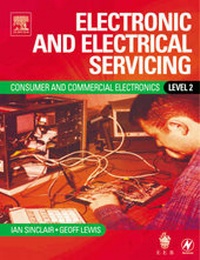
Electronic and Electrical Servicing: Consumer and Commercial Electronics Core Units Level 2
Published on 20. March 2002
Book
Paperback/Softback
320 pages
978-0-7506-5423-4 (ISBN)
Description
"Electronic and Electrical Servicing: Level 2" is the key to success in City & Guilds/EEB courses in electronic servicing, providing a thorough grounding in the electronics and electrical principles required by service engineers. Ian Sinclair and Geoff Lewis have been the leading authors of books for electronic servicing courses for over 20 years, helping many thousands of students through their college courses and NVQs into successful careers. This textbook is designed to provide complete coverage of the five core units of the new Level 2 Progression Award from City & Guilds/EEB (6958): Electrical and Electronics Servicing (Consumer/Commercial Electronics). It also offers a fully up-to-date course text for City & Guilds 2240 Part 1 and underpinning knowledge for Level 2 NVQs from City & Guilds and EMTA. It is endorsed by EEB as a text for the new Level 2 Progression Award (also covers 2240 Part 1). This book covers all 5 core units of the level 2 Progression Award in one book. It is based on the classic Sinclair and Lewis titles, "Servicing Electronic Systems vol. 1" and "Electrical and Electronic Servicing".
Reviews / Votes
"Covers the new curriculum and are at the appropriate level for both student and course." Course tutor, UKMore details
Language
English
Place of publication
Oxford
United Kingdom
Publishing group
Taylor & Francis Ltd
Target group
College/higher education
Illustrations
Approx. 150 illustrations
Dimensions
Height: 246 mm
Width: 189 mm
Weight
630 gr
ISBN-13
978-0-7506-5423-4 (9780750654234)
Copyright in bibliographic data and cover images is held by Nielsen Book Services Limited or by the publishers or by their respective licensors: all rights reserved.
Schweitzer Classification
Other editions
New editions
Book
10/2007
2nd Edition
Newnes
€77.10
Shipment within 15-20 days
Persons
Ian Sinclair was born in 1932 in Tayport, Fife, and graduated from the University of St. Andrews in 1956. In that year, he joined the English Electric Valve Co. in Chelmsford, Essex, to work on the design of specialised cathode-ray tubes, and later on small transmitting valves and TV transmitting tubes. In 1966, he became an assistant lecturer at Hornchurch Technical College, and in 1967 joined the staff of Braintree College of F.E. as a lecturer. His first book, Understanding Electronic Components was published in 1972, and he has been writing ever since, particularly for the novice in Electronics or Computing. The interest in computing arose after seeing a Tandy TRS80 in San Francisco in 1977, and of his 204 published books, about half have been on computing topics, starting with a guide to Microsoft Basic on the TRS80 in 1979. He left teaching in 1984 to concentrate entirely on writing, and has also gained experience in computer typesetting, particularly for mathematical texts. He has recently visited Seattle to see Microsoft at work, and to remind them that he has been using Microsoft products longer than most Microsoft employees can remember. Ian Sinclair is the author of the following Made Simple books: Lotus 1-2-3- (2.4 DOS version) MS-DOS (up to version 6.22) PagePlus for Windows 3.1 Hard drives He is also the author of many other books published under our Newnes imprint.Visit Ian's website at http://website.lineone.net/~ian_sinclair Geoff Lewis has spent many years in most branches of engineering including: motor vehicles, aeronautical, communication, telecommunication, production as an engineer, teacher, lecturer, technical author. Geoff has a keen interest in environmental engineering including hydropower generated inventions. He has written on most of the above subjects, including 10 books, many journal articles and given public lectures. Geoff has long appreciated that knowledge is never wasted and that learning is a life long adventure. He has been told on many occasions that he has the ability to express complex concepts in a fairly easily understandable manner at least this attribute is at the back of his mind when writing.
Content
Preface; Unit 1: Health and safety: D.c. technology: Resistors, networks and measurements: Heat topics; Unit 2: Alternating currents: Capacitance, capacitors, inductance and inductors: A.c. mains supply and practical electronis methods; Unit 3: Semiconductor diodes: Transistors and ICs: Unit 4: Waves and waveforms: Input and output transducers: Electronic modules; Unit 5: Combinational logic: Multivibrators, timers and logic circuits: Digital inputs and outputs; Unit 6: Audio, radio transmission and reception: Television technology; Unit 7: Control systems and transducers: Instrumentation and control systems; Unit 8: The PC computer: Data storage devices: Input and output devices: Printers; Appendices; Index.