

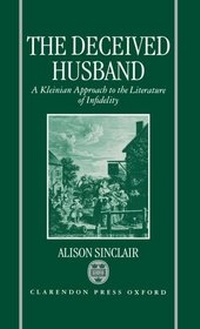
The Deceived Husband
A Kleinian Approach to the Literature of Infidelity
Published on 25. November 1993
Book
Hardback
320 pages
978-0-19-815190-6 (ISBN)
Description
The Deceived Husband is an ambitious and original study of the representation in European literature of adultery, focusing in particular on the figure of the husband.
Drawing on psychoanalysis, and primarily the work of Melanie Klein, Dr Sinclair argues that the differing representations of the deceived husband evidence anxieties within patriarchal society about gender and power, and ultimately about death and the unknown. Detailed discussions of a wide range of texts including The Canterbury Tales, The Decameron, Othello, Madame Bovary, Effi Briest, Anna Karenina, La Regenta, and Flaubert's Parrot reveal that fundamental anxieties about masculinity are repeatedly articulated in two main characterizations of the deceived husband: the cuckold and the man of honour. These are representations which can be usefully understood, the book shows, with reference to the two early developmental positions forwarded by Klein: the paranoid schizoid and the depressive positions.
Innovative and challenging, The Deceived Husband is an important examination of a previously neglected aspect of European literature and to psychoanalytic literary criticism in general.
Drawing on psychoanalysis, and primarily the work of Melanie Klein, Dr Sinclair argues that the differing representations of the deceived husband evidence anxieties within patriarchal society about gender and power, and ultimately about death and the unknown. Detailed discussions of a wide range of texts including The Canterbury Tales, The Decameron, Othello, Madame Bovary, Effi Briest, Anna Karenina, La Regenta, and Flaubert's Parrot reveal that fundamental anxieties about masculinity are repeatedly articulated in two main characterizations of the deceived husband: the cuckold and the man of honour. These are representations which can be usefully understood, the book shows, with reference to the two early developmental positions forwarded by Klein: the paranoid schizoid and the depressive positions.
Innovative and challenging, The Deceived Husband is an important examination of a previously neglected aspect of European literature and to psychoanalytic literary criticism in general.
Reviews / Votes
What may not exactly be unheard-of but is unusual and original in Alison Sinclair's study is her postfeminist focus on fictional portrayals of men who have been betrayed and humiliated. * Journal of Hispanic Research 3 (1194-95) *More details
Language
English
Place of publication
Oxford
United Kingdom
Publishing group
Oxford University Press
Target group
College/higher education
Professional and scholarly
Dimensions
Height: 220 mm
Width: 146 mm
Thickness: 24 mm
Weight
516 gr
ISBN-13
978-0-19-815190-6 (9780198151906)
Copyright in bibliographic data and cover images is held by Nielsen Book Services Limited or by the publishers or by their respective licensors: all rights reserved.
Schweitzer Classification
Person
Content
Part 1The deceived husband - a theoretical introduction. Part 2 Cuckoldry, honour and adultery - the landguage of infidelity. Part 3 The cuckold: the cuckold and his reader; "The Cantebury Tales"; "The Decameron". Part 4 Men of honour: the context; wife-murder - drama in Spain; "Othello" - the obverse of honour. Part 5 The adulteress's husband: models of deception - Charles Bovary, Trevelyan, Instetten; triangles of transition - "La Regenta"; denial and splitting - "Dombey and Son", "The Kreutzer Sonata"; family containment in "Anna Karenina". Part 6 Men of distinction. Part 7 Conclusion: love and death.