

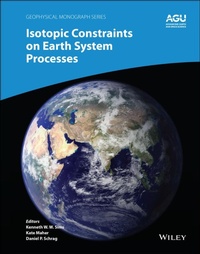
Isotopic Constraints on Earth System Processes
1st Edition
Published on 30. June 2022
Book
Hardback
400 pages
978-1-119-59497-0 (ISBN)
Description
Using isotopes as a tool for understanding Earth processes
From establishing the absolute age of the Earth to providing a stronger understanding of the nexus between geology and life, the careful measurement and quantitative interpretation of minor variations in the isotopic composition of Earth's materials has provided profound insight into the origins and workings of our planet.
Isotopic Constraints on Earth System Processes presents examples of the application of numerous different isotope systems to address a wide range of topical problems in Earth system science.
Volume highlights include:
examination of the natural fractionation of non-traditional stable isotopes from theoretical and experimental to petrologic and metabolic
application of isotopes to understand the origin and evolution of magmas that give rise to the Earth's oceanic and continental crust
utilizing isotopes to understand volcanic systems, from the genesis of large ignimbrites to monitoring of active volcanos
application of isotopes to interrogate and understand Earth's Carbon and Oxygen cycles through geologic time
examination of the geochemical and hydrologic processes that lead to isotopic fractionation in metal, metalloid, and actinide isotope systems
application of isotopic reactive transport models to decipher hydrologic and biogeochemical processes
The American Geophysical Union promotes discovery in Earth and space science for the benefit of humanity. Its publications disseminate scientific knowledge and provide resources for researchers, students, and professionals.
From establishing the absolute age of the Earth to providing a stronger understanding of the nexus between geology and life, the careful measurement and quantitative interpretation of minor variations in the isotopic composition of Earth's materials has provided profound insight into the origins and workings of our planet.
Isotopic Constraints on Earth System Processes presents examples of the application of numerous different isotope systems to address a wide range of topical problems in Earth system science.
Volume highlights include:
examination of the natural fractionation of non-traditional stable isotopes from theoretical and experimental to petrologic and metabolic
application of isotopes to understand the origin and evolution of magmas that give rise to the Earth's oceanic and continental crust
utilizing isotopes to understand volcanic systems, from the genesis of large ignimbrites to monitoring of active volcanos
application of isotopes to interrogate and understand Earth's Carbon and Oxygen cycles through geologic time
examination of the geochemical and hydrologic processes that lead to isotopic fractionation in metal, metalloid, and actinide isotope systems
application of isotopic reactive transport models to decipher hydrologic and biogeochemical processes
The American Geophysical Union promotes discovery in Earth and space science for the benefit of humanity. Its publications disseminate scientific knowledge and provide resources for researchers, students, and professionals.
More details
Series
Language
English
Place of publication
New York
United States
Target group
Professional and scholarly
Dimensions
Height: 279 mm
Width: 220 mm
Thickness: 20 mm
Weight
1157 gr
ISBN-13
978-1-119-59497-0 (9781119594970)
Copyright in bibliographic data and cover images is held by Nielsen Book Services Limited or by the publishers or by their respective licensors: all rights reserved.
Schweitzer Classification
Other editions
Additional editions
Kenneth W. W. Sims | Katharine (Kate) Maher | Daniel P. Schrag
Isotopic Constraints on Earth System Processes
E-Book
04/2022
1st Edition
Wiley
€158.99
Available for download
Kenneth W. W. Sims | Katharine (Kate) Maher | Daniel P. Schrag
Isotopic Constraints on Earth System Processes
E-Book
04/2022
1st Edition
Wiley
€158.99
Available for download
Persons
Kenneth W. W. Sims, University of Wyoming, USA
Kate Maher, Stanford University, USA
Daniel P. Schrag, Harvard University, USA
Kate Maher, Stanford University, USA
Daniel P. Schrag, Harvard University, USA
Content
Preface
Dedication
Part 1 High-Temperature / Deep Earth Processes
1. High-Temperature Kinetic Isotope Fractionation of Silicate Materials
Frank M. Richter
2. Ca and K isotope fractionation by diffusion in molten silicates: Large concentration gradients are not required to induce large diffusive isotope effects
James M. Watkins, John N. Christensen, Donald J. DePaolo, and Frederick J. Ryerson
3. Calcium isotope constraints on recycled carbonates in subduction-related magmas
Justin I. Simon
4. Reassessing the Role of Continental Lithospheric Mantle in Cenozoic Magmatism, Southwestern North America
G. Lang Farmer
5. Rhyolite ignimbrite generation in the Northern Andes: The Chalupas caldera, Ecuador
Lisa Hammersley, Donald J. DePaolo, Bernardo Beate, and Alan L. Deino
6. Xenolith constraints on "self-assimilation" and the origin of low 18O values in Mauna Kea basalts
John C. Lassiter, Danny W. Anderson, Daniel Villanueva-Lascurain, Edward W. Marshall, and Jaime D Barnes
7. Monitoring volcanic activity through combined measurements of CO2 efflux and (222Rn) and (220Rn) in soil gas: an application to Mount Etna (Italy)
Salvatore Giammanco and Kenneth W. W. Sims
Part II Low-Temperature / Shallow Earth Processes
8. The Carbon Isotope Record and Earth Surface Oxygenation
Thomas A. Laakso and Daniel P. Schrag
9. Detrital Garnet Geochronology: A New Window into Ancient Tectonics and Sedimentary Provenance
Kathryn A. Maneiro, Michelle K. Jordan, and Ethan F. Baxter
10. Development of Cr, Se, U, Sb, and Te isotopes as indicators of redox reactions, contaminant fate, and contaminant transport in aqueous systems: A review
Thomas M. Johnson, Jennifer L. Druhan, Anirban Basu, Noah E. Jemison, Xiangli Wang, Kathrin Schilling, and Naomi L. Wasserman
11. The Effects of Reactive Transport on Sulfur Isotopic Compositions in Natural Environments
Alexandra V. Turchyn and Jennifer L. Druhan
12. A Reactive Transport Framework Describing Covariation in the Isotopic Ratios of Multiple Elements in Natural Systems
Jennifer L. Druhan and Alexandra V. Turchyn
13. Stable Ca Isotope Fractionation in Cenozoic Marine Mammals: Beyond Biomineralization & Trophic Positioning
Cole M. Messa, Kenneth W.W. Sims, Sean R. Scott, and Mark T. Clementz
Dedication
Part 1 High-Temperature / Deep Earth Processes
1. High-Temperature Kinetic Isotope Fractionation of Silicate Materials
Frank M. Richter
2. Ca and K isotope fractionation by diffusion in molten silicates: Large concentration gradients are not required to induce large diffusive isotope effects
James M. Watkins, John N. Christensen, Donald J. DePaolo, and Frederick J. Ryerson
3. Calcium isotope constraints on recycled carbonates in subduction-related magmas
Justin I. Simon
4. Reassessing the Role of Continental Lithospheric Mantle in Cenozoic Magmatism, Southwestern North America
G. Lang Farmer
5. Rhyolite ignimbrite generation in the Northern Andes: The Chalupas caldera, Ecuador
Lisa Hammersley, Donald J. DePaolo, Bernardo Beate, and Alan L. Deino
6. Xenolith constraints on "self-assimilation" and the origin of low 18O values in Mauna Kea basalts
John C. Lassiter, Danny W. Anderson, Daniel Villanueva-Lascurain, Edward W. Marshall, and Jaime D Barnes
7. Monitoring volcanic activity through combined measurements of CO2 efflux and (222Rn) and (220Rn) in soil gas: an application to Mount Etna (Italy)
Salvatore Giammanco and Kenneth W. W. Sims
Part II Low-Temperature / Shallow Earth Processes
8. The Carbon Isotope Record and Earth Surface Oxygenation
Thomas A. Laakso and Daniel P. Schrag
9. Detrital Garnet Geochronology: A New Window into Ancient Tectonics and Sedimentary Provenance
Kathryn A. Maneiro, Michelle K. Jordan, and Ethan F. Baxter
10. Development of Cr, Se, U, Sb, and Te isotopes as indicators of redox reactions, contaminant fate, and contaminant transport in aqueous systems: A review
Thomas M. Johnson, Jennifer L. Druhan, Anirban Basu, Noah E. Jemison, Xiangli Wang, Kathrin Schilling, and Naomi L. Wasserman
11. The Effects of Reactive Transport on Sulfur Isotopic Compositions in Natural Environments
Alexandra V. Turchyn and Jennifer L. Druhan
12. A Reactive Transport Framework Describing Covariation in the Isotopic Ratios of Multiple Elements in Natural Systems
Jennifer L. Druhan and Alexandra V. Turchyn
13. Stable Ca Isotope Fractionation in Cenozoic Marine Mammals: Beyond Biomineralization & Trophic Positioning
Cole M. Messa, Kenneth W.W. Sims, Sean R. Scott, and Mark T. Clementz