

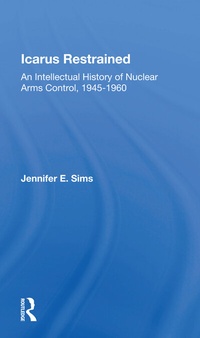
Icarus Restrained
An Intellectual History Of Nuclear Arms Control, 1945-1960
1st Edition
Published on 19. October 2020
Book
Paperback/Softback
264 pages
978-0-367-16310-5 (ISBN)
Description
This book presents a study of the nature and origins of the dominant postwar approach to strategic nuclear arms control in an attempt to clarify it, distinguish it from others, and begin to explain the qualities which made it so attractive and eventually so widely accepted.
More details
Language
English
Place of publication
London
United Kingdom
Publishing group
Taylor & Francis Ltd
Target group
College/higher education
Dimensions
Height: 229 mm
Width: 140 mm
Weight
510 gr
ISBN-13
978-0-367-16310-5 (9780367163105)
Copyright in bibliographic data and cover images is held by Nielsen Book Services Limited or by the publishers or by their respective licensors: all rights reserved.
Schweitzer Classification
Other editions
Additional editions

E-Book
05/2019
1st Edition
Routledge
€59.49
Available for download

E-Book
05/2019
1st Edition
Routledge
€59.49
Available for download
Book
04/2019
1st Edition
Routledge
€179.51
Shipment within 15-20 days
Person
Jennifer E. Simsreceived her B.A. from Oberlin College in June 1975 with a major in Government. In May 1978 she completed her M.A. at Johns Hopkins University School of Advanced International Studies (SAIS) with concentrations in the fields of European Politics, American Foreign Policy, and International Economics. In June 1985 she completed the Ph.D. program in American Foreign Policy, also at SAIS. Graduate work was supported by scholarships from the Arms Control and Disarmament Agency (Hubert H. Humphrey Fellow, 1979) and from the Johns Hopkins University. Dr. Sims has worked with the Istituto per gli Studi di Politica lnternazionale (ISPI) in Rome, Italy, and as a research associate at the International Institute for Strategic Studies (DSS) in London. She is currently American Coordinator of the multinational Nuclear History Program at the University of Maryland.
Content
Part One: Delimiting the Approach 1. Introduction 2. The Cambridge Approach Part Two: Arms Control as Political Instrument 3. The Age of Atomic Innocence 4. The Open World: Arms Control as an Instrument for Achieving Long-Term Political Stability Part Three: Arms Control as Security Instrument 5. From the Age of Innocence to the Balance of Terror: Nuclear Arms Control Thought Comes of Age Introduction 6. Arms Control Theorists of the 1950s Introduction 7. The Cambridge Approach Revisited and Reviewed the Theoretical Joining