

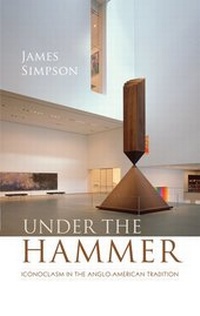
Under the Hammer
Iconoclasm in the Anglo-American Tradition
1st Edition
Published on 30. November 2010
Book
Hardback
238 pages
978-0-19-959165-7 (ISBN)
Description
When we think of breaking images, we assume that it happens somewhere else. We also tend to think of iconoclasts as barbaric. Iconoclasts are people like the Taliban, who blew up Buddhist statues in 2001. We tend, that is, to look with horror on iconoclasm.
This book argues instead that iconoclasm is a central strand of Anglo-American modernity. Our horror at the destruction of art derives in part from the fact that we too did, and still do, that. This is most obviously true of England's iconoclastic century between 1538 and 1643. That century of legislated early modern image breaking, exceptional in Europe for its jurisdictional extension and duration, stands at the core of this book. That's when written texts, especially poems, rather than visual images became our living monuments.
Surely, though, the story of image breaking stops in the eighteenth century, with its enlightened cultivation of the visual arts and the art market. Not so, argues Under the Hammer: once started, iconoclasm is difficult to stop. It ripples through cultures, into the psyche, and it ripples through history. Museums may have protected images from the iconoclast's hammer, but also subject images to metaphorical iconoclasm. Aesthetics may have drawn a protective circle around the image, but as it did so, it also neutralised the image.
The ripple effect also continues across the Atlantic, into puritan culture, into twentieth-century American Abstract Expressionism, and into the puritan temple of modern art. That, in fact, is where this book starts, with mid-twentieth-century abstract painting: the image has survived, just, but it bears the scars of a 500 year history.
This book argues instead that iconoclasm is a central strand of Anglo-American modernity. Our horror at the destruction of art derives in part from the fact that we too did, and still do, that. This is most obviously true of England's iconoclastic century between 1538 and 1643. That century of legislated early modern image breaking, exceptional in Europe for its jurisdictional extension and duration, stands at the core of this book. That's when written texts, especially poems, rather than visual images became our living monuments.
Surely, though, the story of image breaking stops in the eighteenth century, with its enlightened cultivation of the visual arts and the art market. Not so, argues Under the Hammer: once started, iconoclasm is difficult to stop. It ripples through cultures, into the psyche, and it ripples through history. Museums may have protected images from the iconoclast's hammer, but also subject images to metaphorical iconoclasm. Aesthetics may have drawn a protective circle around the image, but as it did so, it also neutralised the image.
The ripple effect also continues across the Atlantic, into puritan culture, into twentieth-century American Abstract Expressionism, and into the puritan temple of modern art. That, in fact, is where this book starts, with mid-twentieth-century abstract painting: the image has survived, just, but it bears the scars of a 500 year history.
Reviews / Votes
beautifully written and illustrated ... This is a splendid book from which anyone trained in medieval or early modern literature, art history, religious studies, theology, or philosophy, could certainly profit ... Simpson's brilliant and provocative book actually becomes an insight into a profound "absence" in Anglo- American modern culture. * Brenda Deen Schildgen, The Medieval Review * what makes this book worth reading is its focus on ... the "exhaustion" of the ceaseless struggle to escape the image since the Protestant Reformation. ... What is compelling about all of this is that even though one might take issue, as a specialist, with certain of Simpson's readings of history or historical texts and objects, it reminds us to be vigilant against our own scholarly idols and our tendency to view the iconoclastic impulse as Other. * Alexa Sand, The Sixteenth Century Journal *More details
Series
Language
English
Place of publication
Oxford
United Kingdom
Target group
College/higher education
Students and scholars of English literature and art historians
Illustrations
45 s/w Abbildungen
45 black-and-white halftones
Dimensions
Height: 224 mm
Width: 150 mm
Thickness: 18 mm
Weight
398 gr
ISBN-13
978-0-19-959165-7 (9780199591657)
Copyright in bibliographic data and cover images is held by Nielsen Book Services Limited or by the publishers or by their respective licensors: all rights reserved.
Schweitzer Classification
Other editions
Additional editions
E-Book
11/2010
OUP eBook
€20.99
Available for download
Person
James Simpson is Donald P. and Katherine B. Loker Professor of English at Harvard University (2004-). He was previously Professor of Medieval and Renaissance English at the University of Cambridge (1999-2003). He is a Life Fellow of Fellow of Girton College and an Honorary Fellow of the Australian Academy of the Humanities. His books include Piers Plowman: An Introduction to the B-Text (Longman, 1990); Sciences and the Self in Medieval Poetry (Cambridge University Press, 1995); Reform and Cultural Revolution, being Volume 2 in the Oxford English Literary History (Oxford University Press, 2002) (winner of the British Academy Sir Israel Gollancz Prize, 2007); and Burning to Read: English Fundamentalism and its Reformation Opponents (Harvard University Press, 2007) (winner of the Silver Medal, 2008 Independent Publisher Book Awards, religion category).
Content
ACKNOWLEDGEMENTS ; CONTENTS ; FIGURES ; INTRODUCTION ; CONCLUSION ; ABBREVIATIONS ; NOTES ; WORKS CITED ; INDEX