

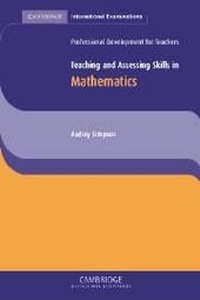
Teaching and Assessing Skills in Mathematics
Published on 6. March 2003
Book
Paperback/Softback
84 pages
978-0-521-75361-6 (ISBN)
Description
The handbooks provide clear practical and up-to-date adviceon teaching and assessing skills across a range of core subject areas for IGCSE and O Level;they can also be used by teachers delivering local syllabuses in the subject. They offer ideas and strategies for effective classroom practice, the setting of coursework, assessing students' work and the integration of different skills. Readers can 'dip into' the books to read up on a particular topic or approach and the material is relevant to both new and experienced teachers alike. All authors are experienced teachers, teacher trainers and examiners.
More details
Series
Language
English
Place of publication
Cambridge
United Kingdom
Target group
Primary & secondary/elementary & high school
Interest Age: From 14 to 16 years
Product notice
Paperback (trade)
Dimensions
Height: 228 mm
Width: 153 mm
Thickness: 4 mm
Weight
150 gr
ISBN-13
978-0-521-75361-6 (9780521753616)
Copyright in bibliographic data and cover images is held by Nielsen Book Services Limited or by the publishers or by their respective licensors: all rights reserved.
Schweitzer Classification
Other editions
New editions
Charlie Gilderdale | Alison Kiddle | Ems Lord
Approaches to Learning and Teaching Mathematics
A Toolkit for International Teachers
Book
08/2017
Cambridge University Press
€37.00
Shipment within 15-20 days
Content
Introduction; Part 1. Communication in Mathematics: 1. The spoken and written language of Mathematics; 2. The symbolic language of Mathematics; Part 2. Practical work in Mathematics: 3. Using a calculator; 4. Trigonometry; 5. Graphs; 6. Transformations; Part 3. Planning and preparing the Mathematics course: 7. Planning the order of work; 8. Building worksheets with graded examples; 9. The role of the answer sheet; 10. Photocopiable sample worksheets; Part 4. Problem solving: Part 5. Revision and preparation for the examination; 11. Construction of students' notebooks of definitions and formulae; 12. Using mnemonics and other devices; 13. How to maximise marks by avoiding the common pitfalls; 14. The use of past examination papers; Conclusion