

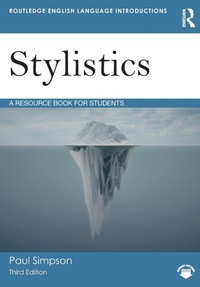
Stylistics
A Resource Book for Students
3rd Edition
Published on 28. October 2025
Book
Paperback/Softback
320 pages
978-1-032-21753-6 (ISBN)
Description
Written in a clear and accessible style, Stylistics, Third Edition is a comprehensive resource which covers all the major theories, concepts and methods required for the investigation of language in literature. From metre to metaphor, dialogue to discourse, the main topics are introduced and fully elaborated, as are the key research paradigms of this important and exciting field of study. Stylistics is richly illustrated with many examples from literary texts, including writing from the established literary canon alongside more contemporary work in poetry, prose and drama. Each of the book's 12 chapters contains clearly framed suggestions for practical work and is accompanied by an original reading on the relevant topic by a world-renowned scholar.
This exciting new third edition builds on the strengths of the first and second by adding fresh exercises and worked examples. It captures the major developments in stylistics, from earlier work that draws on syntax, semantics and phonology, to more recent approaches such as corpus, cognitive and multimodal approaches to the study of style. The accompanying online materials feature, amongst other things, useful links, worked examples and a strand on style and humour. This third edition brings in more texts from contemporary women writers and from writing in more diverse 'Englishes'. In addition to the classic essays in stylistics contained in previous editions, this edition includes three new Section D readings to reflect more recent innovations in the field.
Written by an experienced teacher and researcher, this accessible textbook is an essential resource for all students of English language, linguistics and literature.
This exciting new third edition builds on the strengths of the first and second by adding fresh exercises and worked examples. It captures the major developments in stylistics, from earlier work that draws on syntax, semantics and phonology, to more recent approaches such as corpus, cognitive and multimodal approaches to the study of style. The accompanying online materials feature, amongst other things, useful links, worked examples and a strand on style and humour. This third edition brings in more texts from contemporary women writers and from writing in more diverse 'Englishes'. In addition to the classic essays in stylistics contained in previous editions, this edition includes three new Section D readings to reflect more recent innovations in the field.
Written by an experienced teacher and researcher, this accessible textbook is an essential resource for all students of English language, linguistics and literature.
More details
Series
Edition
3rd edition
Language
English
Place of publication
London
United Kingdom
Publishing group
Taylor & Francis Ltd
Target group
College/higher education
Undergraduate
Illustrations
4 s/w Photographien bzw. Rasterbilder, 17 s/w Zeichnungen, 13 s/w Tabellen, 21 s/w Abbildungen
13 Tables, black and white; 17 Line drawings, black and white; 4 Halftones, black and white; 21 Illustrations, black and white
Dimensions
Height: 244 mm
Width: 170 mm
Thickness: 18 mm
Weight
585 gr
ISBN-13
978-1-032-21753-6 (9781032217536)
Copyright in bibliographic data and cover images is held by Nielsen Book Services Limited or by the publishers or by their respective licensors: all rights reserved.
Schweitzer Classification
Other editions
Additional editions
Book
10/2025
3rd Edition
Routledge
€207.10
Shipment within 10-20 days
E-Book
10/2025
3rd Edition
Routledge
€61.99
Available for download
E-Book
10/2025
3rd Edition
Routledge
€61.99
Available for download
Previous edition
Book
01/2014
2nd Edition
Routledge
€53.50
Article exhausted; check for reprint
Person
Paul Simpson is the Baines Professor of English Language in the Department of English at Liverpool University, UK.
Content
Preface A Introduction: key concepts in stylistics 1 What is stylistics? 2 Stylistics and levels of language 3 Grammar and style 4 Rhythm and metre 5 Narrative stylistics 6 Style as choice 7 Style and point of view 8 Representing speech and thought 9 Dialogue and discourse 10 Cognitive stylistics 11 Metaphor and metonymy 12 Corpus stylistics B Development: doing stylistics 1 Developments in stylistics 2 Levels of language at work: an example from poetry 3 Sentence styles: development and illustration 4 Interpreting patterns of sound 5 Developments in structural narratology 6 Style and transitivity 7 Approaches to point of view 8 Techniques of speech and thought presentation 9 Dialogue in drama 10 Developments in cognitive stylistics 11 Styles of metaphor 12 Developments in corpus stylistics C Exploration: investigating style 1 Is there a 'literary language'? 2 Style, register and dialect 3 Grammar and genre: a short study in Imagism 4 Stylistics and re-writing: an example from prose fiction 5 A sociolinguistic model of narrative 6 Transitivity, characterisation and literary genre 7 Exploring point of view in narrative fiction 8 A workshop on speech and thought presentation 9 Exploring dialogue 10 Cognitive stylistics at work 11 Exploring metaphors in different kinds of texts 12 Using corpora in stylistic analysis D Extension: readings in stylistics 1 Stylistics and the teaching of literature (Henry Widdowson) 2 Style and verbal play (Katie Wales) 3 Teaching grammar and style (Ronald Carter) 4 Sound, style and onomatopoeia (Derek Attridge) 5 Style shifting and Jamaican Creole (Naomi Adam) 6 Transitivity at work (Deirdre Burton) 7 Style variation and point of view (Mick Short) 8 The effects of free indirect discourse (Joe Bray) 9 Multimodal analysis and the stylistics of drama (Dan McIntyre) 10 From lexical semantics to conceptual integration theory (Patricia Canning and Paul Simpson) 11 Cognitive stylistics and the theory of metaphor (Peter Stockwell) 12 Doing corpus stylistics: A practical guide (Suzanne McClure) Further reading References