

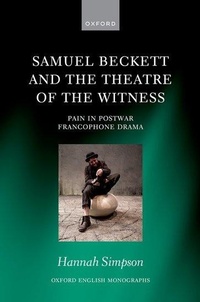
Samuel Beckett and the Theatre of the Witness
Pain in Post-War Francophone Drama
Published on 9. June 2022
Book
Hardback
202 pages
978-0-19-286326-3 (ISBN)
Description
Samuel Beckett and the Theatre of the Witness explores Beckett's representation of physical pain in his theatre plays in the long aftermath of World War II, emphasising how the issues raised by this staging of pain speak directly to matters lying at the heart of his work: the affective power of the human body; the doubtful capacity of language as a means of communication; the aesthetic and ethical functioning of the theatre medium; and the vexed question of intersubjective empathy. Alongside the wartime and post-war plays of fellow Francophone writers Albert Camus, Eugene Ionesco, Pablo Picasso, and Marguerite Duras, this study resituates Beckett's early plays in a new conceptualising of le theatre du temoin or a 'theatre of the witness'. These are plays concerned with the epistemological and ethical uncertainties of witnessing another's pain, rather than with the sufferer's own direct experience. They raise troubling questions about our capacity to comprehend and respond to another being's pain. Drawing on an interdisciplinary framework of extant criticism, recorded historical audience response, theatre and affect theory, and medical understandings of bodily pain, Hannah Simpson argues that these plays do not offer any easily negotiable encounter with physical suffering, pushing us to recognise the very 'otherness' of another being's pain, even as it invades our own affective sphere. In place of any comforting transcendence or redemption of endured pain, they offer a starkly sceptical, even pessimistic probing of what it is to witness another's suffering.
Reviews / Votes
A wide-ranging and important book, incisively argued, original and compelling... It will be an important reference point in future scholarship, orienting research in modern French literary studies, and at the intersection of pain studies and literary studies, for some time to come. * David Houston Jones, French Studies * Ironically, it is a pleasure to read Hannah Simpson's study on pain in Samuel Beckett's theatre. Through cogent rereadings of a number of canonical Beckett works, Simpson demonstrates the potential for an interdisciplinary approach to pain... a valuable resource for Beckett scholars hoping not to think through pain but think with it. * Trask Roberts, Journal of Modern Literature * In Samuel Beckett and the Theatre of the Witness, Hannah Simpson orients our attention to the multiplicities of pain found in and disappeared from the postwar theatrical productions of Samuel Beckett. She demonstrates how the central themes of Beckett's oeuvre - corporeal (dis)functioning, the impotence of language, the (im)possibility for intersubjective understanding - are illuminated through the manner in which Beckett writes and stages pain. * Trask Roberts, Kent State University * As a medical humanities and Beckett studies researcher, I believe the book provides innovative and strongly justified concepts of spectatorship that can help understand various nuances of the term. * Swati Joshi, Theatre Research International 48.3 *More details
Series
Language
English
Place of publication
Oxford
United Kingdom
Target group
Professional and scholarly
Product notice
sewn/stitched
Cloth over boards
Dimensions
Height: 237 mm
Width: 164 mm
Thickness: 18 mm
Weight
485 gr
ISBN-13
978-0-19-286326-3 (9780192863263)
Copyright in bibliographic data and cover images is held by Nielsen Book Services Limited or by the publishers or by their respective licensors: all rights reserved.
Schweitzer Classification
Other editions
Additional editions
E-Book
05/2022
1st Edition
OUP eBook
€49.99
Available for download
E-Book
05/2022
1st Edition
OUP eBook
€49.99
Available for download
Person
Hannah Simpson is the Rosemary Pountney Junior Research Fellow at St Anne's College, University of Oxford. She is also the Theatre Review Editor at The Beckett Circle.
Content
Introduction: 'PAIN PAIN PAIN': Samuel Beckett, World War II, and Francophone Theatre
1: The Indifferent Spectator: Eleutheria and Albert Camus
2: Cruelty, Contagion, and Comedy: Waiting for Godot
3: The Aesthetic of the Anaesthetic: Endgame and Pablo Picasso
4: Transcending Pain, Theatricalising Pain: Happy Days, Play, and Eugene Ionesco
5: Testimony and Trauma: Not I and Marguerite Duras's L'Amante anglaise
Conclusion: Breath: Distance, Intimacy, and the Empathic
1: The Indifferent Spectator: Eleutheria and Albert Camus
2: Cruelty, Contagion, and Comedy: Waiting for Godot
3: The Aesthetic of the Anaesthetic: Endgame and Pablo Picasso
4: Transcending Pain, Theatricalising Pain: Happy Days, Play, and Eugene Ionesco
5: Testimony and Trauma: Not I and Marguerite Duras's L'Amante anglaise
Conclusion: Breath: Distance, Intimacy, and the Empathic