

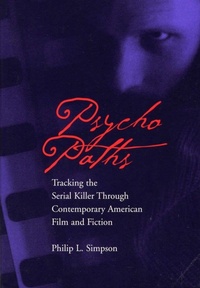
Psycho Paths
Tracking the Serial Killer Through Contemporary American Film and Fiction
3rd Edition
Will be published approx. on 31. October 2000
Book
Paperback/Softback
256 pages
978-0-8093-2329-6 (ISBN)
Description
This is a broad overview of the evolving serial killer genre in the two media most responsible for its popularity: literature and cinema of the 1980s and 1990s. The fictional serial killer, with a motiveless, highly individualized modus operandi, is the latest manifestation of the multiple murderers and homicidal maniacs that haunt American literature and, particularly, visual media such as cinema and television. The author theorizes that the serial killer genre results from a combination of earlier genre depictions of multiple murderers, inherited Gothic storytelling conventions, and threatening folkloric figures reworked over the years into a contemporary mythology of violence. Updated and repackaged for mass consumption, the Gothic villains, the monsters, the vampires and the werewolves of the past have evolved into the fictional serial killer, who clearly reflects American cultural anxieties at the start of the 21st century. Citing numerous sources, the author argues that serial killers' recent popularity as genre monsters owes much to their pliability to any number of authorial ideological agendas from both the left and the right ends of the political spectrum. Serial killers in fiction are a kind of debased and traumatized visionaries, whose murders privately and publicly reempower them with a pseudo-divine aura in the contemporary political moment. The fascination with serial killer narratives can thus be explained as the latest manifestation of the ongoing human fascination with tales of gruesome murders and mythic villains finding a receptive audience in a nation galvanized by the increasingly apocalyptic tension between the extremist philosophies of both the New Right and the anti-New Right. Faced with a blizzard of works of varying quality dealing with the serial killer, Simpson has ruled out the catalogue approach in this study in favour of an in-depth analysis of the best American work in the genre. He has chosen novels and films that have at least some degree of public name-recognition or notoriety, including: ""Red Dragon"" and ""The Silence of the Lambs"", by Thomas Harris; ""Manhunter"", directed by Michael Mann; ""Henry: Portrait of a Serial Killer"", directed by John McNaughton ""Seven"", directed by David Fincher; ""Natural Born Killers"", directed by Oliver Stone; ""Zombie"", by Joyce Caol Oates; and ""American Psycho"", by Bret Easton Ellis.
More details
Edition
Third Edition
Language
English
Place of publication
Carbondale
United States
Target group
College/higher education
Professional and scholarly
Edition type
New edition
Dimensions
Height: 233 mm
Width: 156 mm
Thickness: 17 mm
Weight
398 gr
ISBN-13
978-0-8093-2329-6 (9780809323296)
Copyright in bibliographic data and cover images is held by Nielsen Book Services Limited or by the publishers or by their respective licensors: all rights reserved.
Schweitzer Classification
Person
Philip L. Simpson is an assistant professor of communications and humanities at the Palm Bay campus of Brevard Community College, Palm Bay Florida.