

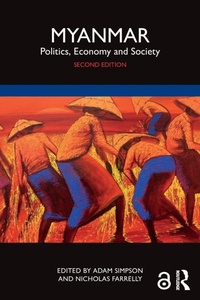
Myanmar
Politics, Economy and Society
2nd Edition
Published on 20. October 2023
Book
Paperback/Softback
324 pages
978-1-032-47810-4 (ISBN)
Description
This new edition of Myanmar: Politics, Economy and Society provides a sophisticated yet accessible overview of the key political, economic and social challenges facing contemporary Myanmar and explains the complex historical and ethnic dynamics that have shaped the country.
Thoroughly revised, the book analyses the context and tragic consequences of the military coup in February 2021 and the COVID-19 pandemic. With clear and incisive contributions from the world's leading Myanmar scholars, this book assesses the policies and political reforms that have provoked contestation in Myanmar's recent history and driven both economic and social change. In this context, questions of economic ownership and control and the distribution of natural resources are shown to be deeply informed by long-standing fractures among ethnic and civil-military relations. The chapters analyse the key issues that constrain or expedite societal development in Myanmar and place recent events of national and international significance in the context of its complex history and social relations. The book provides detailed analysis of the coup, which overturned a decade of political and economic reforms and threw the country into chaos. It explains the drivers for the coup, how it has impacted on the country and the future prospects for accountability and justice.
Filling a gap in the market, this research textbook and primer will be of interest to upper undergraduates, postgraduates and scholars of Southeast Asian politics, economics and society and to journalists and professionals working within governments, companies and other organisations.
The Open Access version of this book, available at http://www.taylorfrancis.com, has been made available under a Creative Commons Attribution-Non Commercial-No Derivatives 4.0 license.
Thoroughly revised, the book analyses the context and tragic consequences of the military coup in February 2021 and the COVID-19 pandemic. With clear and incisive contributions from the world's leading Myanmar scholars, this book assesses the policies and political reforms that have provoked contestation in Myanmar's recent history and driven both economic and social change. In this context, questions of economic ownership and control and the distribution of natural resources are shown to be deeply informed by long-standing fractures among ethnic and civil-military relations. The chapters analyse the key issues that constrain or expedite societal development in Myanmar and place recent events of national and international significance in the context of its complex history and social relations. The book provides detailed analysis of the coup, which overturned a decade of political and economic reforms and threw the country into chaos. It explains the drivers for the coup, how it has impacted on the country and the future prospects for accountability and justice.
Filling a gap in the market, this research textbook and primer will be of interest to upper undergraduates, postgraduates and scholars of Southeast Asian politics, economics and society and to journalists and professionals working within governments, companies and other organisations.
The Open Access version of this book, available at http://www.taylorfrancis.com, has been made available under a Creative Commons Attribution-Non Commercial-No Derivatives 4.0 license.
Reviews / Votes
Praise for the first edition:"[...] a must-read for scholars on contemporary Myanmar and fascinating for anyone interested in broader processes of political and economic transformations. [...] the book is a welcome addition to studies of contemporary Myanmar and deserves to be read widely."
--Marco Buente, European Journal of East Asian Studies
"This excellent survey of Myanmar politics, economy, and society over 17 short chapters is obviously marred by the coup d'etat of 1 February 2021. As an edited volume, the editors introduce and conclude the volume while assigning the 'meat' of the book to various experts on salient issues related to Myanmar's politics, economy, and society. [...] this book is a valuable survey of the issues and challenges facing contemporary Myanmar. While presenting the proximate causes of post-Thein Sein disappointment, it also touches upon and articulately explains the underlying forces, perceptions and prejudices that make achieving peace, let alone democracy, unlikely in this 'fiendish brew' of a country."
--Adam McCarty and Callum Furness, Asian-Pacific Economic Literature, 2022.
More details
Edition
2nd edition
Language
English
Place of publication
London
United Kingdom
Publishing group
Taylor & Francis Ltd
Target group
College/higher education
Postgraduate
Illustrations
1 s/w Abbildung, 1 s/w Photographie bzw. Rasterbild
1 Halftones, black and white; 1 Illustrations, black and white
Dimensions
Height: 234 mm
Width: 156 mm
Thickness: 19 mm
Weight
524 gr
ISBN-13
978-1-032-47810-4 (9781032478104)
Copyright in bibliographic data and cover images is held by Nielsen Book Services Limited or by the publishers or by their respective licensors: all rights reserved.
Schweitzer Classification
Other editions
Additional editions
E-Book
10/2023
2nd Edition
Taylor & Francis
€0.00
Available for download
Book
10/2023
2nd Edition
Routledge
€207.10
Shipment within 10-20 days
E-Book
10/2023
2nd Edition
Taylor & Francis
€0.00
Available for download
Previous edition
Book
09/2020
1st Edition
Routledge
€45.79
Article exhausted; check for reprint
Persons
Adam Simpson is a senior lecturer in international studies within Justice and Society at the University of South Australia. His research adopts a critical perspective and is focused on the politics of the environment, development and democratisation in Southeast Asia, particularly Myanmar and Thailand. He is the author of Energy, Governance and Security in Thailand and Myanmar (Burma): A Critical Approach to Environmental Politics in the South (Routledge 2014) and is lead editor of the Routledge Handbook of Contemporary Myanmar (2018), also published by Routledge.
Nicholas Farrelly is a professor and head of the School of Social Sciences at the University of Tasmania, Australia. His research focuses on political conflict and social change in mainland Southeast Asia, and he has undertaken extensive research across Myanmar. He is co-editor (with Adam Simpson and Ian Holliday) of the Routledge Handbook of Contemporary Myanmar (Routledge 2018).
Nicholas Farrelly is a professor and head of the School of Social Sciences at the University of Tasmania, Australia. His research focuses on political conflict and social change in mainland Southeast Asia, and he has undertaken extensive research across Myanmar. He is co-editor (with Adam Simpson and Ian Holliday) of the Routledge Handbook of Contemporary Myanmar (Routledge 2018).
Content
Chapter 1. Analysing a Disaster, Wrapped in a Catastrophe, Inside a Tragedy; Chapter 2. Deja Vu All Over Again: The 2021 Coup in Historical Perspective Part 1: Politics Chapter 3. Ethnic Politics: Diversity and Agency Amidst Persistent Violence; Chapter 4. The Military: Institution and Politics; Chapter 5. Land and Law Between Reform and Revolution; Chapter 6. Democracy and Human Rights under Military Rule: Three Iterations of Myanmar's National Security State; Chapter 7. Foreign and Diplomatic (Dis)Engagement: Military Priorities, Strategic Realities and Contested Legitimacies Part 2: Economy Chapter 8. Political Regimes and Economic Policy: Isolation, Consolidation, Reintegration and Rupture; Chapter 9. Agriculture and Rural Livelihoods: Incipient Progress Aborted; Chapter 10. Natural Resource Governance and the Environment: Unconstrained Exploitation Under Authoritarianism; Chapter 11. Industrial Policy and Special Economic Zones: Engaging Transformation in a Globalised World Part 3: Society Chapter 12. Art and Heritage: Creating and Preserving Cultural Histories; Chapter 13. Public Health: State and Non-State Systems in a Changing Society; Chapter 14. Education: Reforms Undone; Chapter 15. Women in Myanmar: Change and Continuity; Chapter 16. Myanmar's Contested Borderlands: Centre-Periphery Power Relations and Fragmented Sovereignty; Chapter 17. Ethnicity, Culture and Religion: Centralisation, Burmanisation and Social Transformation; Chapter 18. Journalism and Free Speech: Freedom and Fear; Chapter 19. Myanmar's Complex and Intersecting Crises: Pathways to Accountability and International Justice; Index