

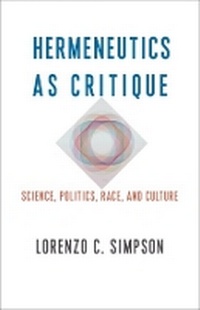
Hermeneutics as Critique
Science, Politics, Race, and Culture
Published on 2. March 2021
Book
Hardback
256 pages
978-0-231-19684-0 (ISBN)
Description
Hermeneutics has frequently been dismissed as useful only for literary and textual analysis. Some consider it to be Eurocentric or inherently relativistic and thus unsuited to social critique. Lorenzo C. Simpson offers a persuasive and powerful argument that hermeneutics is a valuable tool not only for critical theory but also for robustly addressing many of the urgent issues of today.
Simpson demonstrates that hermeneutics exhibits significant interpretive advantages compared to competing explanatory modalities. While it shares with pragmatism a suspicion of essentialism, an understanding that disagreements are situated, and an insistence on the dialogical nature of understanding, it nevertheless resolutely rejects the relativistic accounts of rationality that are often associated with pragmatism. In the tradition of Gadamer, Simpson firmly establishes hermeneutics as a resource for both philosophy and the social sciences. He shows its utility for unpacking intractable issues in the philosophy of science, multiculturalism, social epistemology, and racial and social justice in the global arena. Simpson addresses fraught questions such as why recent claims that "race" has a biological basis lack grounding, whether female genital excision can be critically addressed without invidious ethnocentrism, and how to lay the foundations for meaningful cross-cultural dialogue and reparative justice. This book reveals how hermeneutics can be a worthy partner with critical theory in achieving emancipatory aims.
Simpson demonstrates that hermeneutics exhibits significant interpretive advantages compared to competing explanatory modalities. While it shares with pragmatism a suspicion of essentialism, an understanding that disagreements are situated, and an insistence on the dialogical nature of understanding, it nevertheless resolutely rejects the relativistic accounts of rationality that are often associated with pragmatism. In the tradition of Gadamer, Simpson firmly establishes hermeneutics as a resource for both philosophy and the social sciences. He shows its utility for unpacking intractable issues in the philosophy of science, multiculturalism, social epistemology, and racial and social justice in the global arena. Simpson addresses fraught questions such as why recent claims that "race" has a biological basis lack grounding, whether female genital excision can be critically addressed without invidious ethnocentrism, and how to lay the foundations for meaningful cross-cultural dialogue and reparative justice. This book reveals how hermeneutics can be a worthy partner with critical theory in achieving emancipatory aims.
Reviews / Votes
Hermeneutics as Critique is a substantive intellectual contribution on multiple fronts. -- Magnus Ferguson * Research in Phenomenology * Simpson's book is a stunning intellectual achievement that deftly demonstrates the power of philosophical hermeneutics to illuminate ongoing debates about scientific theory choice, the nature and autonomy of human agency, and the biological significance of race. The argumentation is learned and precise, the depth of philosophical insight extraordinary! -- Robert Gooding-Williams, author of <i>In the Shadow of Du Bois: Afro-Modern Political Thought in America</i> I know of no other book expansive enough to cover issues in hermeneutics, critical theory, the philosophy of science, multiculturalism, race, social epistemology, and global justice at all, much less in the depth that Lorenzo Simpson covers them in Hermeneutics as Critique. Here Simpson takes the tradition of hermeneutics to the next level with clarity, elegance, and insight. -- Georgia Warnke, author of <i>After Identity: Rethinking Race, Sex, and Gender</i> In this engaging study, Simpson reaffirms the relevance of a critical hermeneutics for the full range of human inquiry and practice, including science, politics, and sociocultural understanding. He decisively rebuts the common charge of relativism and makes original and valuable contributions to discussions about critical rationality, social agency, race, and cross-cultural interpretation. -- Kenneth Baynes, author of <i>Habermas</i> Lorenzo Simpson's Hermeneutics as Critique is a path-breaking contribution to the defense of hermeneutics, not just as a method of text interpretation but also as a critical philosophy with wide-ranging power to illuminate cultural dilemmas. Hermeneutics is commonly understood to espouse a coherentist account of truth and a contextualist understanding of culture; as such, it seems devoid of an ideology-critical moment to invalidate established types and classifications or repudiate cultural belief systems. Through a lucid and elegantly written account, Simpson shows how hermeneutics can be practiced as a critical philosophy of science and of culture. The best contribution to the hermeneutics-critical theory discussion since the Habermas-Gadamer debate. -- Seyla Benhabib, professor emerita of political science and philosophy at Yale University and senior research fellow at Columbia Law SchoolMore details
Series
Language
English
Place of publication
New York
United States
Target group
Professional and scholarly
Product notice
Trade binding
Dimensions
Height: 216 mm
Width: 140 mm
ISBN-13
978-0-231-19684-0 (9780231196840)
Copyright in bibliographic data and cover images is held by Nielsen Book Services Limited or by the publishers or by their respective licensors: all rights reserved.
Schweitzer Classification
Other editions
Additional editions
Book
03/2021
Columbia University Press
€37.20
Shipment within 10-20 days
E-Book
02/2021
1st Edition
Columbia University Press
€33.99
Available for download
Person
Lorenzo C. Simpson is professor of philosophy at Stony Brook University. His books include Technology, Time, and the Conversations of Modernity (1995) and The Unfinished Project: Towards a Postmetaphysical Humanism (2001).
Content
Preface and Acknowledgments
Introduction
1. Twin Earth and Its Horizons: On Hermeneutics, Reference, and Scientific Theory Choice
2. Critical Fusions: Toward a Genuine "Hermeneutics of Suspicion"
3. Agency, the "Politics of Memory," and Reparative Justice: Hermeneutics and the Politics of Development
4. Toward a Hermeneutics of Race: Biology, Race, Ethnicity, and Culture
5. Concluding Reflections: Toward a New Reconciliation of Hermeneutics and Critical Theory, or Notes Toward a Hermeneutic Democracy
Appendix: Toward a Hermeneutics of the Ethical Response
Notes
Bibliography
Index
Introduction
1. Twin Earth and Its Horizons: On Hermeneutics, Reference, and Scientific Theory Choice
2. Critical Fusions: Toward a Genuine "Hermeneutics of Suspicion"
3. Agency, the "Politics of Memory," and Reparative Justice: Hermeneutics and the Politics of Development
4. Toward a Hermeneutics of Race: Biology, Race, Ethnicity, and Culture
5. Concluding Reflections: Toward a New Reconciliation of Hermeneutics and Critical Theory, or Notes Toward a Hermeneutic Democracy
Appendix: Toward a Hermeneutics of the Ethical Response
Notes
Bibliography
Index