

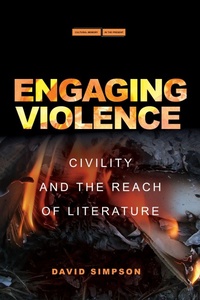
Engaging Violence
Civility and the Reach of Literature
Published on 6. September 2022
Book
Paperback/Softback
304 pages
978-1-5036-3308-7 (ISBN)
Description
Recent thinking has resuscitated civility as an important paradigm for engaging with a violence that must be deemed endemic to our lives. But, while it is widely acknowledged that civility works against violence, and that literature generates or accompanies civility and engenders tolerance, civility has also been understood as violence in disguise, and literature, which has only rarely sought to claim the power of violence, has often been accused of inciting it. This book sets out to describe the ways in which these words-violence, literature and civility-and the concepts they evoke are mutually entangled, and the uses to which these entanglements have been put.
Simpson's argument follows a broadly historical trajectory through the long modern period from the Renaissance to the present, drawing on the work of historians, political scientists, literary scholars and philosophers. The result is a distinctly new argument about the complex and often mystified entanglements between literature, civility and violence in the anglophone Atlantic sphere. What now are our expectations of civility and literature, separately and together? How do these long-familiar but residually imprecise concepts stand up to the demands of the modern world? Simpson's argument is that, despite and perhaps because of their imperfect conceptualization, both persist as important protocols for the critique of violence.
Simpson's argument follows a broadly historical trajectory through the long modern period from the Renaissance to the present, drawing on the work of historians, political scientists, literary scholars and philosophers. The result is a distinctly new argument about the complex and often mystified entanglements between literature, civility and violence in the anglophone Atlantic sphere. What now are our expectations of civility and literature, separately and together? How do these long-familiar but residually imprecise concepts stand up to the demands of the modern world? Simpson's argument is that, despite and perhaps because of their imperfect conceptualization, both persist as important protocols for the critique of violence.
Reviews / Votes
"Among the most important literary historical considerations of violence and civility to emerge in recent decades, this remarkable, challenging book sustains the question of how-and at what cost-civility has been opposed to violence, and literature allied with civility."-Judith Butler, University of California, Berkeley "This timely, erudite work is not polemical, not a defense, but reflective-essayistic rather than thesis-driven. In these ways and more, the book enacts a form of civility that it characterizes and appreciates without idealizing."-Jonathan Arac, University of Pittsburgh "Engaging Violence is dialectical criticism at its best. It follows the overlapping histories of civility and literary pedagogy over time as both engage with different forms of violence, and it renders the complex historical process by which each term shifts as it moves between contexts but never admits of monolithic conclusions."-Kevis Goodman, Critical InquiryMore details
Series
Edition
New edition
Language
English
Place of publication
Palo Alto
United States
Target group
Professional and scholarly
Edition type
New edition
Product notice
Paperback (trade)
Dimensions
Height: 226 mm
Width: 148 mm
Thickness: 20 mm
Weight
422 gr
ISBN-13
978-1-5036-3308-7 (9781503633087)
Copyright in bibliographic data and cover images is held by Nielsen Book Services Limited or by the publishers or by their respective licensors: all rights reserved.
Schweitzer Classification
Other editions
Additional editions
E-Book
09/2022
Stanford University Press
from
€52.99
Available for download
Person
David Simpson is Distinguished Professor and G.B. Needham Chair, emeritus, at the University of California, Davis. His most recent book is States of Terror: History, Theory, Literature (2019).
Content
Introduction
1. Civility and Literature and Their Discontents
2. Civil Beginnings
3. Philosophy Polite and Politic
4. The Displacement of Civility: Violence in a Widening World
5. Civility after 1989: Romancing Small Groups
6. The Reach of Literature
1. Civility and Literature and Their Discontents
2. Civil Beginnings
3. Philosophy Polite and Politic
4. The Displacement of Civility: Violence in a Widening World
5. Civility after 1989: Romancing Small Groups
6. The Reach of Literature