

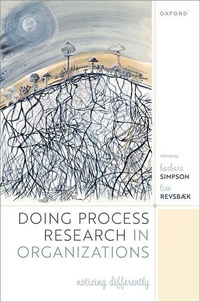
Doing Process Research in Organizations
Noticing Differently
Published on 22. September 2022
Book
Hardback
256 pages
978-0-19-284963-2 (ISBN)
Description
This book takes up the challenge that process philosophy and process ontology pose to conventional, entity-based empirical research, even daring to question the relevance of 'methodology' in contemporary process organization studies. A process ontology demands reimagining and ongoing reinvention of how researchers inquire into and engage with the movements and moments of a morphing world. This in turn requires us to notice differently in our empirical engagements.
Contributors to this book share a commitment to research that is more-than-representational in its concern to notice and act-with the latencies and diversities of living experience. Drawing inspiration from process philosophies, posthuman subjectivities, post qualitative inquiry, art, poetics, cinematics, and aesthetics, the chapters actively manifest the doing, reading, and writing of process research by attuning to occasions, moments, atmospheres, affects, agencements, with-ness, difference, and multiplicity. In bringing these ideas alive, the authors engage with their own empirical unfoldings by means of communing, corresponding, caring, performative writing, depersonalization, subject proliferation, mindfulness, relating, slow seeing, rhythmanalysis, listening, chromatic empiricism, and diffraction. Each chapter offers a unique worlding constituted in the particular elements it brings together, affording a style of reading that is oriented towards sensing rather than knowing or mastery. The chapters can be read in any order, alone or with and through each other. Collectively they evoke a mycelial web of resonance travelling across, between, and beyond the contents of this book.
Contributors to this book share a commitment to research that is more-than-representational in its concern to notice and act-with the latencies and diversities of living experience. Drawing inspiration from process philosophies, posthuman subjectivities, post qualitative inquiry, art, poetics, cinematics, and aesthetics, the chapters actively manifest the doing, reading, and writing of process research by attuning to occasions, moments, atmospheres, affects, agencements, with-ness, difference, and multiplicity. In bringing these ideas alive, the authors engage with their own empirical unfoldings by means of communing, corresponding, caring, performative writing, depersonalization, subject proliferation, mindfulness, relating, slow seeing, rhythmanalysis, listening, chromatic empiricism, and diffraction. Each chapter offers a unique worlding constituted in the particular elements it brings together, affording a style of reading that is oriented towards sensing rather than knowing or mastery. The chapters can be read in any order, alone or with and through each other. Collectively they evoke a mycelial web of resonance travelling across, between, and beyond the contents of this book.
More details
Language
English
Place of publication
Oxford
United Kingdom
Product notice
sewn/stitched
Cloth over boards
Dimensions
Height: 237 mm
Width: 158 mm
Thickness: 24 mm
Weight
584 gr
ISBN-13
978-0-19-284963-2 (9780192849632)
Copyright in bibliographic data and cover images is held by Nielsen Book Services Limited or by the publishers or by their respective licensors: all rights reserved.
Schweitzer Classification
Other editions
Additional editions
E-Book
09/2022
1st Edition
OUP eBook
€80.49
Available for download
E-Book
08/2022
1st Edition
OUP eBook
€80.49
Available for download
Persons
From an early career as a physics-trained geothermal hydrologist and environmental scientist, Barbara Simpson, a New Zealander by birth, turned to organization studies and moved to Scotland to pursue her interests in what makes organizations work. She was drawn to the practical philosophies of American Pragmatists, especially Mead, and has used these as a springboard into thinking more dynamically about organizations and their processes. Dissatisfied with the surprisingly static nature of much process theory she has, in recent years, been pursuing process ontology as a potentially rich, though undeniably challenging, way to extend her appreciation of practising in organizational contexts. She is Professor of Leadership and Organisational Dynamics at the University of Strathclyde.
Line Revsbaek is Associate Professor of Organizational Processes in the Department of Culture and Learning at Aalborg University, Denmark. Building on her background as an organizational psychologist, she is concerned to innovate participatory and change-oriented research practices. Her research interests are innovation and learning dynamics in organizations. She works from process philosophy, particularly Pragmatism and the philosophy of George Herbert Mead, to suggest process ontological practices such as those offered in 'Analyzing in the Present' (co-authored with Lene Tanggaard, Qualitative Inquiry) and working from 'Resonant experience in emergent events of analysis' (Qualitative Studies).
Line Revsbaek is Associate Professor of Organizational Processes in the Department of Culture and Learning at Aalborg University, Denmark. Building on her background as an organizational psychologist, she is concerned to innovate participatory and change-oriented research practices. Her research interests are innovation and learning dynamics in organizations. She works from process philosophy, particularly Pragmatism and the philosophy of George Herbert Mead, to suggest process ontological practices such as those offered in 'Analyzing in the Present' (co-authored with Lene Tanggaard, Qualitative Inquiry) and working from 'Resonant experience in emergent events of analysis' (Qualitative Studies).
Content
- 1: Line Revsbæk and Barbara Simpson: Why Does Process Research Require us to Notice Differently?
- 2: Silvia Gherardi and Michela Cozza: Atmospheric Attunement in the Becoming of a Happy Object: 'That Special Gut Feeling'
- 3: Ariana Amacker and Anna Rylander Eklund: Arts-Based Techniques in Process Research: Learning to See the Forest for the Tree
- 4: Charlotte Wegener: Rhythms of Writing: Connecting (with) Words
- 5: Anne Augustine: Diffractive Inquiring, or How I Came to Care
- 6: Stephen Linstead: Seeing and Hearing in the Poetics and Cinematics of Research: Wandering Through a Sea of Fog into a Blizzard of Black Snow
- 7: Timon Beyes: Noticing Colour: Shades of a Chromatic Empiricism
- 8: Sideeq Mohammed: The Ethnographer as Conceptual Persona: On the Many Shopping Centres
- 9: Boris H. J. M. Brummans: Eight Ways to Notice Mindfully in Process Organization Studies
- 10: Katie Beavan: Correspondences with a Business Meeting in a Time of COVID
- 11: Alecia Y. Jackson, Lisa A. Mazzei, Line Revsbæk, and Barbara Simpson: Opening Conversation on Doing Process Research