

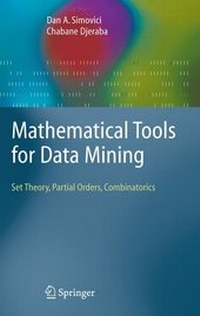
Mathematical Tools for Data Mining
Set Theory, Partial Orders, Combinatorics
Published on 15. August 2008
Book
Hardback
XII, 615 pages
978-1-84800-200-5 (ISBN)
Description
This volume was born from the experience of the authors as researchers and educators,whichsuggeststhatmanystudentsofdataminingarehandicapped in their research by the lack of a formal, systematic education in its mat- matics. The data mining literature contains many excellent titles that address the needs of users with a variety of interests ranging from decision making to p- tern investigation in biological data. However, these books do not deal with the mathematical tools that are currently needed by data mining researchers and doctoral students. We felt it timely to produce a book that integrates the mathematics of data mining with its applications. We emphasize that this book is about mathematical tools for data mining and not about data mining itself; despite this, a substantial amount of applications of mathematical c- cepts in data mining are presented. The book is intended as a reference for the working data miner. In our opinion, three areas of mathematics are vital for data mining: set theory,includingpartially orderedsetsandcombinatorics;linear algebra,with its many applications in principal component analysis and neural networks; and probability theory, which plays a foundational role in statistics, machine learning and data mining. Thisvolumeisdedicatedtothestudyofset-theoreticalfoundationsofdata mining. Two further volumes are contemplated that will cover linear algebra and probability theory. The ?rst part of this book, dedicated to set theory, begins with a study of functionsandrelations.Applicationsofthesefundamentalconceptstosuch- sues as equivalences and partitions are discussed. Also, we prepare the ground for the following volumes by discussing indicator functions, ?elds and?-?elds, and other concepts.
Reviews / Votes
From the reviews:
"The book is organized into four parts, with a total of 15 chapters. Each chapter . offers numerous exercises and references for further reading. . Overall, Simovici and Djeraba's presentation of both the theoretical grounds and the practical aspects of the various data mining methodologies is good. . The book is intended for readers who have a data mining background . . It will help this audience to improve their knowledge of how different data mining strategies operate from a mathematical standpoint." (Aris Gkoulalas-Divanis, ACM Computing Reviews, February, 2009)
More details
Series
Edition
2008
Language
English
Place of publication
London
United Kingdom
Target group
College/higher education
Research
Product notice
Laminated cover
Illustrations
81 s/w Abbildungen, 5 s/w Tabellen
81 black & white illustrations, 5 black & white tables, biography
Dimensions
Height: 23.5 cm
Width: 15.6 cm
Thickness: 34 mm
Weight
2330 gr
ISBN-13
978-1-84800-200-5 (9781848002005)
DOI
10.1007/978-1-84800-201-2
Schweitzer Classification
Other editions
New editions
Dan A. Simovici | Chabane Djeraba
Mathematical Tools for Data Mining
Set Theory, Partial Orders, Combinatorics
Book
04/2014
2nd Edition
Springer
€192.59
Shipment within 15-20 days
Additional editions
Dan A. Simovici | Chaabane Djeraba
Mathematical Tools for Data Mining
Set Theory, Partial Orders, Combinatorics
Book
10/2010
Springer
€160.49
Article exhausted; check different version
Dan A. Simovici | Chaabane Djeraba
Mathematical Tools for Data Mining
Set Theory, Partial Orders, Combinatorics
E-Book
08/2008
1st Edition
Springer
€149.79
Available for download
Content
Set Theory.- Sets, Relations, and Functions.- Algebras.- Graphs and Hypergraphs.- Partial Orders.- Partially Ordered Sets.- Lattices and Boolean Algebras.- Topologies and Measures.- Frequent Item Sets and Association Rules.- Applications to Databases and Data Mining.- Rough Sets.- Metric Spaces.- Dissimilarities, Metrics, and Ultrametrics.- Topologies and Measures on Metric Spaces.- Dimensions of Metric Spaces.- Clustering.- Combinatorics.- Combinatorics.- The Vapnik-Chervonenkis Dimension.