

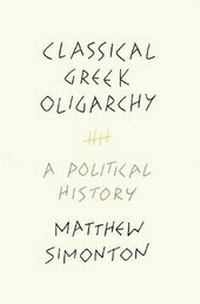
Classical Greek Oligarchy
A Political History
Published on 27. June 2017
Book
Hardback
376 pages
978-0-691-17497-6 (ISBN)
Description
Classical Greek Oligarchy thoroughly reassesses an important but neglected form of ancient Greek government, the "rule of the few." Matthew Simonton challenges scholarly orthodoxy by showing that oligarchy was not the default mode of politics from time immemorial, but instead emerged alongside, and in reaction to, democracy. He establishes for the first time how oligarchies maintained power in the face of potential citizen resistance. The book argues that oligarchs designed distinctive political institutions--such as intra-oligarchic power sharing, targeted repression, and rewards for informants--to prevent collective action among the majority population while sustaining cooperation within their own ranks. To clarify the workings of oligarchic institutions, Simonton draws on recent social science research on authoritarianism. Like modern authoritarian regimes, ancient Greek oligarchies had to balance coercion with co-optation in order to keep their subjects disorganized and powerless.
The book investigates topics such as control of public space, the manipulation of information, and the establishment of patron-client relations, frequently citing parallels with contemporary nondemocratic regimes. Simonton also traces changes over time in antiquity, revealing the processes through which oligarchy lost the ideological battle with democracy for legitimacy. Classical Greek Oligarchy represents a major new development in the study of ancient politics. It fills a longstanding gap in our knowledge of nondemocratic government while greatly improving our understanding of forms of power that continue to affect us today.
The book investigates topics such as control of public space, the manipulation of information, and the establishment of patron-client relations, frequently citing parallels with contemporary nondemocratic regimes. Simonton also traces changes over time in antiquity, revealing the processes through which oligarchy lost the ideological battle with democracy for legitimacy. Classical Greek Oligarchy represents a major new development in the study of ancient politics. It fills a longstanding gap in our knowledge of nondemocratic government while greatly improving our understanding of forms of power that continue to affect us today.
Reviews / Votes
"Co-Winner of the 2018 Runciman Award, The Anglo-Hellenic League" "A valuable exploration of the means by which Greek oligarchic regimes sought to maintain themselves in power."---P. J. Rhodes, Sehepunkte "[A] fascinating and insightful book."---Ganesh Sitaraman, Guardian "Meticulous, accessible, and insightful, Simonton presents a fresh and much-needed account of oligarchy and how it worked during antiquity. . . . Classical Greek Oligarchy is a masterful book."---Lee Trepanier, voegelview.com "Stimulating and thought-provoking. . . . I would happily recommend this book to scholars of Classical history and politics."---Daniel B. Unruh, Classical Review "Remarkable and innovative. . . . This book is a major contribution to the political history of the classical antiquity and to classical scholarship at large. There is no doubt it will soon become a must-read for all students of ancient Greek history and ancient Greek political thought . . . [and] will most likely prove engaging far beyond the field of classical scholarship."---Marek Wecowski, Ancient History Bulletin "Highly recommended." * Choice * "Well-researched, clearly written, and vigorously argued."---Greg Anderson, American Historical Review "An important and pioneering book."---Alex Gottesman, Classical World "A densely argued and challenging book. . . . All serious students of ancient political history will need to engage with it."---Philip Harding, Phoenix Journal "Simonton's social science perspective provides a highly productive theoretical framework: by drawing on New Institutionalism he is able to shed new light on patchy evidence and make a major contribution to ancient political history. This theoretical framework is well integrated into the discussion of the ancient source material so that it has genuine explanatory power rather than being alienating to the reader unfamiliar with this literature."---Claire Taylor, Polis, The Journal for Ancient Greek and Roman Political Thought (AGPT)More details
Language
English
Place of publication
New Jersey
United States
Target group
College/higher education
Professional and scholarly
Product notice
Trade binding
Illustrations
1 Maps
Dimensions
Height: 235 mm
Width: 152 mm
Weight
680 gr
ISBN-13
978-0-691-17497-6 (9780691174976)
Copyright in bibliographic data and cover images is held by Nielsen Book Services Limited or by the publishers or by their respective licensors: all rights reserved.
Schweitzer Classification
Other editions
Additional editions
E-Book
06/2017
1st Edition
Princeton University Press
from
€161.95
Available for download
Person
Matthew Simonton is assistant professor of history in the School of Humanities, Arts, and Cultural Studies at Arizona State University. He received his PhD in classics from Stanford University.
Content
Preface ix Acknowledgments xiii Abbreviations and Conventions xv 1 Problem, Background, Method 1 2 Oligarchic Power-Sharing 75 3 Balancing Coercion and Co-optation 107 4 The Politics of Public Space 148 5 The Manipulation of Information 186 6 Processes of Regime Breakdown 224 Afterword: The Eclipse of Oligarchia 275 Appendix 287 Works Cited 291 Index Locorum 323 General Index 343