

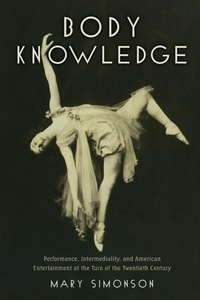
Body Knowledge
Performance, Intermediality, and American Entertainment at the Turn of the Twentieth Century
Published on 17. October 2013
Book
Paperback/Softback
304 pages
978-0-19-989803-9 (ISBN)
Description
In the early twentieth century, female performers regularly appeared on the stages and screens of American cities. Though advertised as dancers, mimics, singers, or actresses, they often exceeded these categories. Instead, their performances adopted an aesthetic of intermediality, weaving together techniques and elements drawn from a wide variety of genres and media, including ballet, art music, photography, early modern dance, vaudeville traditions, film, and more. Onstage and onscreen, performers borrowed from existing musical scores and narratives, referred to contemporary shows, films, and events, and mimicked fellow performers, skating neatly across various media, art forms, and traditions. Behind the scenes, they experimented with cross-promotion, new advertising techniques, and various technologies to broadcast images and tales of their performances and lives well beyond the walls of American theaters, cabarets, and halls. The performances and conceptions of art that emerged were innovative, compelling, and deeply meaningful.
Body Knowledge: Performance, Intermediality, and American Entertainment at the Turn of the Twentieth Century examines these performances and the performers behind them, highlighting the Ziegfeld Follies and The Passing Show revues, Salome dancers, Isadora Duncan's Wagner dances, Adeline Genee and Bessie Clayton's "photographic" danced histories, Hazel Mackaye and Ruth St. Denis's pageants, and Anna Pavlova's opera and film projects. By destabilizing the boundaries between various media, genres, and performance spaces, each of these women was able to create performances that negotiated turn-of-the-century American social and cultural issues: contemporary technological developments and the rise of mass reproduction, new modes of perception, the commodification of art and entertainment, the evolution of fan culture and stardom, changing understandings of the body and the self, and above all, shifting conceptions of gender, race, and sexual identity. Tracing the various modes of intermediality at work on- and offstage, Body Knowledge re-imagines early twentieth-century art and entertainment as both fluid and convergent.
Body Knowledge: Performance, Intermediality, and American Entertainment at the Turn of the Twentieth Century examines these performances and the performers behind them, highlighting the Ziegfeld Follies and The Passing Show revues, Salome dancers, Isadora Duncan's Wagner dances, Adeline Genee and Bessie Clayton's "photographic" danced histories, Hazel Mackaye and Ruth St. Denis's pageants, and Anna Pavlova's opera and film projects. By destabilizing the boundaries between various media, genres, and performance spaces, each of these women was able to create performances that negotiated turn-of-the-century American social and cultural issues: contemporary technological developments and the rise of mass reproduction, new modes of perception, the commodification of art and entertainment, the evolution of fan culture and stardom, changing understandings of the body and the self, and above all, shifting conceptions of gender, race, and sexual identity. Tracing the various modes of intermediality at work on- and offstage, Body Knowledge re-imagines early twentieth-century art and entertainment as both fluid and convergent.
Reviews / Votes
Delves into scholarship that has been either ignored or misinterpreted by other researchers... The superior research and clear prose make this book a welcome addition to the scholarship on this era. Highly recommended. * Choice * A compelling and deeply researched book that weaves together dance, music, cultural history, gender roles, faddishness, fandom, historical awareness, emerging media, and multimedia interaction in a complex but highly readable fashion. Its strengths are the focus on women's performance, particularly the negotiation of their bodies as display and identity - something at great stake in an era when women were fighting for the vote even as issues of race complicate matters mightily - and the nuance of reading individual moments and their relationships to each other * Robynn Stilwell, Georgetown University * Simonson moves us expertly through the rich interchange of live and mediatized American stage cultures of the early 20th century. Through tableaux vivants, filmed opera, pageantry and other spectacles, Simonson resituates our understanding of modernist/post-Victorian performances by giving them the intermedial context they merit. Of great interest to anyone in performance studies, whether in stage, film, music, and especially dance. * Caryl Flinn, Professor of Screen Arts and Cultures, University of Michigan * Beautifully researched, rich with compellingly told stories, Body Knowledge offers very smart analyses of how representations and performances of embodiment leap media and genre barriers. A must-read for scholars of musical embodiment. * Suzanne G. Cusick, New York University *More details
Language
English
Place of publication
New York
United States
Target group
College/higher education
Professional and scholarly
Illustrations
8 music examples and 21 photographs
Dimensions
Height: 234 mm
Width: 156 mm
Thickness: 18 mm
Weight
521 gr
ISBN-13
978-0-19-989803-9 (9780199898039)
Copyright in bibliographic data and cover images is held by Nielsen Book Services Limited or by the publishers or by their respective licensors: all rights reserved.
Schweitzer Classification
Other editions
Additional editions
Mary Simonson
Body Knowledge
Performance, Intermediality, and American Entertainment at the Turn of the Twentieth Century
E-Book
09/2013
1st Edition
OUP eBook
€15.49
Available for download
Person
Mary Simonson is Lecturer in Womens Studies and Film & Media Studies at Colgate University.
Content
List of Illustrations ; List of Musical Examples ; Acknowledgements ; Prologue: Staging Intermediality: Darktown, Downtown ; 1. Choreographing Salome: Recreating the Female Body ; 2. Acting Ancient: Hellenism, Pageantry, and American Modernity ; 3. Dancing Music: Isadora Duncan and Wagnerism in the American Imagination ; 4. Dancing Pictures: Rita Sacchetto's Tanzbilder ; 5. Moving Images: Adeline Genee and Bessie Clayton's Danced Histories ; 6. Opera on Camera, Opera on Stage: Anna Pavlova and The Dumb Girl of Portici ; Finale: Performing Intermediality in The Passing Show of 1913 ; Bibliography ; Index