

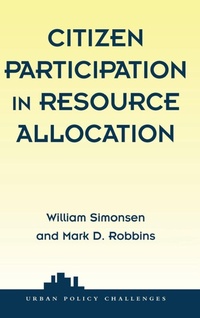
Citizen Participation In Resource Allocation
1st Edition
Published on 28. August 2019
Book
Hardback
200 pages
978-0-367-31500-9 (ISBN)
Description
Not all citizens seek to extract a '`'free lunch' from government by demanding more services at the same time that they eschew taxes. It is possible to gather the insights of an representative and informed citizenry in sophisticated and reliable form. Citizen Participation in Resource Allocation explores the means to obtaining informed insight from
More details
Language
English
Place of publication
London
United Kingdom
Publishing group
Taylor & Francis Ltd
Target group
College/higher education
Dimensions
Height: 235 mm
Width: 157 mm
Thickness: 15 mm
Weight
448 gr
ISBN-13
978-0-367-31500-9 (9780367315009)
Copyright in bibliographic data and cover images is held by Nielsen Book Services Limited or by the publishers or by their respective licensors: all rights reserved.
Schweitzer Classification
Other editions
Additional editions
William Simonsen
Citizen Participation In Resource Allocation
E-Book
10/2018
1st Edition
Routledge
€55.49
Available for download
William Simonsen
Citizen Participation In Resource Allocation
E-Book
10/2018
1st Edition
Routledge
€55.49
Available for download
William Simonsen
Citizen Participation In Resource Allocation
Book
12/1999
1st Edition
Westview Press Inc
€63.00
Shipment within 10-20 days

William Simonsen | Mark Robbins
Citizen Participation In Resource Allocation
Book
12/1999
1st Edition
Westview Press Inc
€126.28
Article exhausted; check different version
Person
William Simonsen is associate professor in the Department of Planning, Public Policy and Management at the University of Oregon, where he has taught since 1990. Mark D. Robbins is assistant professor of political science at the University of Georgia.
Content
Introduction -- Theoretical and Historical Context of Public Participation -- Contemporary Techniques for Citizen Involvement -- How Do Citizens Balance the Budget? -- How Fiscal Information and Service Use Influence Citizen Preferences -- Conclusions: Lessons for Governments