

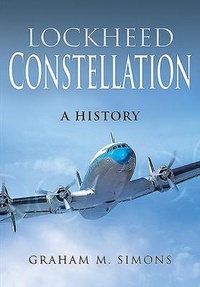
Lockheed Constellation
A History
Published on 29. June 2021
Book
Hardback
256 pages
978-1-5267-5886-6 (ISBN)
Description
Clarence 'Kelly' Johnson's design for the Lockheed Constellation, known affectionately as the 'Connie', produced one of the world's most iconic airliners.
Lockheed had been working on the L-044 Excalibur, a four-engine, pressurised airliner, since 1937\. In 1939, Trans World Airlines, at the instigation of major stockholder Howard Hughes, requested a 40-passenger transcontinental aircraft with a range of 3,500 miles, well beyond the capabilities of the Excalibur design. TWA's requirements led to the L-049 Constellation, designed by Lockheed engineers including Kelly Johnson and Hall Hibbard.
Between 1943 and 1958, Lockheed built 856 Constellations in numerous models at its Burbank, California, factory - all with the same distinctive and immediately recognisable triple-tail design and dolphin-shaped fuselage.
The Constellation was used as a civil airliner and as a military and civilian air transport, seeing service in the Berlin and the Biafran airlifts. Three of them served as the presidential aircraft for Dwight D. Eisenhower. After the Second World War, TWA's trans-Atlantic service began on 6 February 1946 with a New York-Paris flight in a Constellation. Then, on 17 June 1947, Pan Am opened the first-ever scheduled round-the-world service with their L-749 Clipper America.
In this revealing insight into the Lockheed Constellation, the renowned aviation historian Graham M. Simons examines its design, development and service, both military and civil. In doing so, he reveals the story of a design which, as the first pressurised airliner in widespread use, helped to usher in affordable and comfortable air travel around the world.
Lockheed had been working on the L-044 Excalibur, a four-engine, pressurised airliner, since 1937\. In 1939, Trans World Airlines, at the instigation of major stockholder Howard Hughes, requested a 40-passenger transcontinental aircraft with a range of 3,500 miles, well beyond the capabilities of the Excalibur design. TWA's requirements led to the L-049 Constellation, designed by Lockheed engineers including Kelly Johnson and Hall Hibbard.
Between 1943 and 1958, Lockheed built 856 Constellations in numerous models at its Burbank, California, factory - all with the same distinctive and immediately recognisable triple-tail design and dolphin-shaped fuselage.
The Constellation was used as a civil airliner and as a military and civilian air transport, seeing service in the Berlin and the Biafran airlifts. Three of them served as the presidential aircraft for Dwight D. Eisenhower. After the Second World War, TWA's trans-Atlantic service began on 6 February 1946 with a New York-Paris flight in a Constellation. Then, on 17 June 1947, Pan Am opened the first-ever scheduled round-the-world service with their L-749 Clipper America.
In this revealing insight into the Lockheed Constellation, the renowned aviation historian Graham M. Simons examines its design, development and service, both military and civil. In doing so, he reveals the story of a design which, as the first pressurised airliner in widespread use, helped to usher in affordable and comfortable air travel around the world.
More details
Language
English
Place of publication
Barnsley
United Kingdom
Publishing group
Pen & Sword Books Ltd
Product notice
sewn/stitched
Cloth over boards
Illustrations
175 colour illustrations
Dimensions
Height: 254 mm
Width: 182 mm
Thickness: 27 mm
Weight
1083 gr
ISBN-13
978-1-5267-5886-6 (9781526758866)
Copyright in bibliographic data and cover images is held by Nielsen Book Services Limited or by the publishers or by their respective licensors: all rights reserved.
Schweitzer Classification
Other editions
Additional editions
E-Book
08/2021
Air World
€5.99
Available for download
Person
GRAHAM M. SIMONS was one of the founders of the world-famous aviation museum at Duxford near Cambridge where his interest was piqued watching the making of the film Battle of Britain there in the late 1960s. From this, and with an engineering background, he progressed to membership of a number of aviation societies, including sitting on the British Aviation Preservation Council, eventually taking the position of Engineering Director with one group. Graham combines his love of writing with his skills in production to create and publish aviation histories focused on a variety of subjects.