

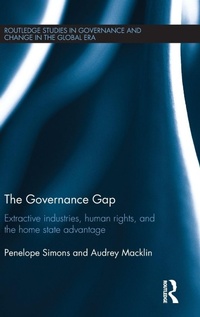
The Governance Gap
Extractive Industries, Human Rights, and the Home State Advantage
1st Edition
Published on 10. February 2014
Book
Hardback
460 pages
978-0-415-33470-9 (ISBN)
Description
This book explores the persistence of the governance gap with respect to the human rights-impacting conduct of transnational extractive corporations operating in zones of weak governance.
The authors launch their account with a fascinating case study of Talisman Energy's experience in Sudan, informed by their own experience as members of the 1999 Canadian Assessment Mission to Sudan (Harker Mission). Drawing on new governance, reflexive law and responsive law theories, the authors assess legal and other non-binding governance mechanisms that have emerged since that time, including the UN Guiding Principles on Business and Human Rights. They conclude that such mechanisms are incapable of systematically preventing human rights violating behaviour by transnational corporations, or of assuring accountability of these actors or recompense for victims of such violations. The authors contend that home state regulation, while not a silver bullet, has a crucial role to play in regulating such conduct. They pick up where UN Special Representative John Ruggie's Guiding Principles on Business and Human Rights left off, and propose an innovative, robust and adaptable template for strengthening the regulatory framework of home states. Their model draws insights from the theoretical literature, leverages existing public, private, transnational, national, 'soft' and hard regulatory tools, and harnesses the specific strengths of state-based governance.
This book will be of interest to academics, policy makers, students, civil society and business leaders.
The authors launch their account with a fascinating case study of Talisman Energy's experience in Sudan, informed by their own experience as members of the 1999 Canadian Assessment Mission to Sudan (Harker Mission). Drawing on new governance, reflexive law and responsive law theories, the authors assess legal and other non-binding governance mechanisms that have emerged since that time, including the UN Guiding Principles on Business and Human Rights. They conclude that such mechanisms are incapable of systematically preventing human rights violating behaviour by transnational corporations, or of assuring accountability of these actors or recompense for victims of such violations. The authors contend that home state regulation, while not a silver bullet, has a crucial role to play in regulating such conduct. They pick up where UN Special Representative John Ruggie's Guiding Principles on Business and Human Rights left off, and propose an innovative, robust and adaptable template for strengthening the regulatory framework of home states. Their model draws insights from the theoretical literature, leverages existing public, private, transnational, national, 'soft' and hard regulatory tools, and harnesses the specific strengths of state-based governance.
This book will be of interest to academics, policy makers, students, civil society and business leaders.
Reviews / Votes
"The authors are to be congratulated. They have produced a well-argued, thoughtful and innovative treatment of a vitally important subject. Their work is a welcome intervention in the important ongoing search for meaningful corporate human rights and environmental accountability in the vulnerability-deepening conditions of contemporary globalisation."-Anna Grear, Professor of Law, Cardiff Law School - Human Rights Law Review "The authors are to be congratulated. They have produced a well-argued, thoughtful and innovative treatment of a vitally important subject. Their work is a welcome intervention in the important ongoing search for meaningful corporate human rights and environmental accountability in the vulnerability-deepening conditions of contemporary globalisation."
-Anna Grear, Professor of Law, Cardiff Law School - Human Rights Law Review
More details
Series
Language
English
Place of publication
London
United Kingdom
Publishing group
Taylor & Francis Ltd
Target group
College/higher education
Professional and scholarly
Postgraduate and Professional
Illustrations
5 s/w Abbildungen, 5 s/w Zeichnungen, 1 s/w Tabelle
1 Tables, black and white; 5 Line drawings, black and white; 5 Illustrations, black and white
Dimensions
Height: 240 mm
Width: 161 mm
Thickness: 29 mm
Weight
854 gr
ISBN-13
978-0-415-33470-9 (9780415334709)
Copyright in bibliographic data and cover images is held by Nielsen Book Services Limited or by the publishers or by their respective licensors: all rights reserved.
Schweitzer Classification
Other editions
Additional editions
Penelope Simons | Audrey Macklin
The Governance Gap
Extractive Industries, Human Rights, and the Home State Advantage
Book
09/2015
1st Edition
Routledge
€85.10
Shipment within 10-20 days
Penelope Simons | Audrey Macklin
The Governance Gap
Extractive Industries, Human Rights, and the Home State Advantage
E-Book
07/2014
1st Edition
Routledge
€77.99
Available for download
Penelope Simons | Audrey Macklin
The Governance Gap
Extractive Industries, Human Rights, and the Home State Advantage
E-Book
07/2014
1st Edition
Routledge
€77.99
Available for download
Persons
Penelope Simons is Associate Professor of Law at the University of Ottawa, Canada.
Audrey Macklin is Professor of Law at the University of Toronto, Canada.
Audrey Macklin is Professor of Law at the University of Toronto, Canada.
Content
1. Introduction 2. Talisman in Sudan 3. The Governance Gap: Multistakeholder and intergovernmental initiatives 4. The Governance Gap: Domestic laws and other governance mechanisms 5. Extractive Industries, Human Rights and the Home State Advantage