

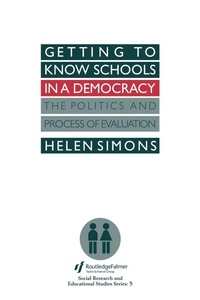
Getting To Know Schools In A Democracy
The Politics And Process Of Evaluation
1st Edition
Published on 21. May 1987
Book
Paperback/Softback
308 pages
978-1-85000-148-5 (ISBN)
Description
First published in 1987. The central concept of the book is that of 'democratic' evaluation, one of the most influential ideas in the development of education practice in this country since professional evaluation emerged in the 1960s. The question explored, through an examination of the theory and practice of democratic evaluation, is whether it is possible to both posit and practice an approach to evaluation that provides an effective curb on the derivatisation and centralisation of information for educational decision-making. The book documents the emergence of politically conscious evaluation in this country and through two detailed cases explores the strengths and weaknesses of democratic theory in practice. Issues concerning the rights, obligations and freedoms of evaluators in the conduct and dissemination of evaluations are discussed.
More details
Language
English
Place of publication
London
United Kingdom
Publishing group
Taylor & Francis Ltd
Target group
College/higher education
Professional and scholarly
Dimensions
Height: 234 mm
Width: 156 mm
Thickness: 17 mm
Weight
477 gr
ISBN-13
978-1-85000-148-5 (9781850001485)
Copyright in bibliographic data and cover images is held by Nielsen Book Services Limited or by the publishers or by their respective licensors: all rights reserved.
Schweitzer Classification
Other editions
Additional editions
Book
06/2017
1st Edition
Routledge
€259.98
Shipment within 10-20 days
E-Book
10/2013
Routledge
€54.99
Available for download
E-Book
10/2013
Routledge
€55.49
Available for download
Person
Helen Simons is Senior Lecturer and Chairperson of the Curriculum Studies Department at the University of London Institute of Education.
Content
Chapter 1 The Nature and Development of Evaluative Inquiry; Chapter 2 The Political Implications of Evaluation Theory: A Closer Look; Chapter 3 The Evolution of the Case Study Approach; Chapter 4 Democratic Principles in Practice: A Case Study in a Comprehensive School; Chapter 5 Losing Control: Reflections on the Case; Chapter 6 The Right to Know: A Dispute about the Dissemination of an Evaluation Report; Chapter 7 What is Reasonable? Reflections on the Case; Chapter 8 The Demand for School Knowledge: For Whom by Whom?; Chapter 9 School Self-Evaluation -Schemes and Scepticism; Chapter 10 Getting to Know Schools - The Next Step;