

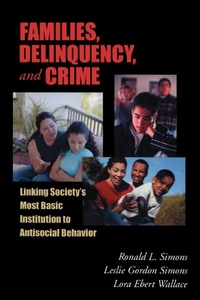
Families, Delinquency, and Crime
Linking Society's Most Basic Institution to Antisocial Behavior
Published on 11. August 2004
Book
Paperback/Softback
232 pages
978-0-19-533042-7 (ISBN)
Description
This book explores the link between family life and antisocial behavior. In recent years, researchers from a variety of disciplines have investigated the relationship between society's most fundamental social institution--the family--and various forms of criminal behavior. Simons et al. fill a fundamental void in the literature by demonstrating how these seemingly disparate lines of research can be woven together using classic and contemporary theories of delinquency and crime. The book is designed to serve as a supplement for courses on juvenile delinquency, criminology, deviance, and child development.
Families, Delinquency, and Crime evaluates and explores popular explanations using the results of studies by sociologists, criminologists, and psychologists. Each chapter succinctly defines terminology, establishes a review of empirical literature, and provides an effective argument that families are a dynamic aspect of our social lives that are intricately related to delinquency and other problem behaviors. Clear examples of each situation are provided.
Part I explains child and adolescent antisocial behavior. The chapters review theory and research regarding the effect of family structure, marital conflict, parental antisocial behavior, and parents' childrearing practices on a child's risk for conduct problems and delinquency. Part II focuses on adult antisocial behavior and shows how the various family socialization processes and childhood behavior problems discussed in Part I influence the probability of later adult crime. Explanations are provided for both the continuity and discontinuity of antisocial behavior across the life course. Consideration is given to the manner in which romantic partners often modify deviant life course trajectories. The book also explores the link between family experiences during childhood and adult risk for either perpetrating or becoming the victim of marital violence.
Families, Delinquency, and Crime evaluates and explores popular explanations using the results of studies by sociologists, criminologists, and psychologists. Each chapter succinctly defines terminology, establishes a review of empirical literature, and provides an effective argument that families are a dynamic aspect of our social lives that are intricately related to delinquency and other problem behaviors. Clear examples of each situation are provided.
Part I explains child and adolescent antisocial behavior. The chapters review theory and research regarding the effect of family structure, marital conflict, parental antisocial behavior, and parents' childrearing practices on a child's risk for conduct problems and delinquency. Part II focuses on adult antisocial behavior and shows how the various family socialization processes and childhood behavior problems discussed in Part I influence the probability of later adult crime. Explanations are provided for both the continuity and discontinuity of antisocial behavior across the life course. Consideration is given to the manner in which romantic partners often modify deviant life course trajectories. The book also explores the link between family experiences during childhood and adult risk for either perpetrating or becoming the victim of marital violence.
Reviews / Votes
This book...provides both an introduction to and the latest knowledge on the subject in a way that is accessible to students and other nonexperts.... After reading the book, I found myself better informed even about issues that I already knew well and had studied in depth. Simons et al. are enthusiastic, engaged, and knowledgeable about the subject of family relationships and antisocial behavior. The content of the book is richly informed, not only by the most recent research and theory in the field but also by the findings from collaborative efforts in the authors' own high-quality research. All of this is presented in a concise and remarkably well-written manner. * Ronald L. Akers, University of Florida *More details
Series
Language
English
Place of publication
New York
United States
Target group
College/higher education
Professional and scholarly
Dimensions
Height: 234 mm
Width: 156 mm
Thickness: 14 mm
Weight
386 gr
ISBN-13
978-0-19-533042-7 (9780195330427)
Copyright in bibliographic data and cover images is held by Nielsen Book Services Limited or by the publishers or by their respective licensors: all rights reserved.
Schweitzer Classification
Persons
Content
PART I: FAMILY PROCESSES AND THE DEVIANT BEHAVIOR OF CHILDREN AND ADOLESCENTS; 1. DEFINING OUR TERMS AND FOCUS; 2. LINKING PARENTING AND DELINQUENCY: THEORIES OF SOCIAL AND SELF-CONTROL; 3. FAMILY INTERACTION AND PEER INFLUENCES: SOCIAL LEARNING EXPLANATIONS; 4. THE CORPORAL PUNISHMENT CONTROVERSY; 5. FAMILY STRUCTURE AND DELINQUENCY; 6. THE EFFECTS OF PARENTAL WORK AND NEIGHBORHOOD CONDITIONS ON FAMILY PROCESSES; PART II: ADULT DEVIANCE AS AN EXPRESSION OF CHILDHOOD SOCIALIZATION; 7. LINKING CHILDHOOD DELINQUENCY AND ADULT CRIME: LIFE COURSE PERSPECTIVES ON ANTISOCIAL BEHAVIOR; 8. MARITAL VIOLENCE: ANTISOCIAL BEHAVIOR; 9. CHILD MALTREATMENT: INEPT PARENTING OR EXPRESSION OF A GENERAL ANTISOCIAL ORIENTATION?; 10. CONCLUSIONS AND OBSERVATIONS