

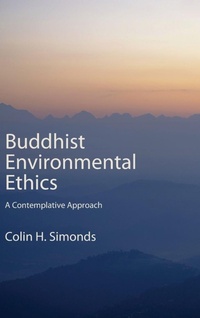
Buddhist Environmental Ethics
A Contemplative Approach
Will be published approx. on 1. December 2025
Book
Hardback
312 pages
979-8-8558-0497-3 (ISBN)
Description
Brings Tibetan Buddhist philosophy, contemplative practice, and contemporary environmental ethics together to present a novel way of approaching the pressing issues facing our more-than-human world.
In Buddhist Environmental Ethics, Colin H. Simonds presents a compelling case for using a contemplative register to approach some of our most pressing issues surrounding climate change, ecological collapse, and the exploitation of nonhuman animals. Simonds develops an emerging theory of Buddhist ethics-moral phenomenology-by engaging it with the Tibetan framework of view, meditation, action and providing a practical means by which individuals can ethically develop through contemplative practice. He then applies this theory and practical framework to the ethical and material problems facing the more-than-human world to show how a Tibetan Buddhist response to these issues offers a cogent, adaptable way to address environmental problems. In doing so, Buddhist Environmental Ethics forwards the first book-length constructive argument for an eco-Buddhist ethic in over a decade, articulates the first environmental ethic based on Tibetan Buddhist sources, and offers a timely framework for how we can experience the more-than-human world anew through contemplative practice.
In Buddhist Environmental Ethics, Colin H. Simonds presents a compelling case for using a contemplative register to approach some of our most pressing issues surrounding climate change, ecological collapse, and the exploitation of nonhuman animals. Simonds develops an emerging theory of Buddhist ethics-moral phenomenology-by engaging it with the Tibetan framework of view, meditation, action and providing a practical means by which individuals can ethically develop through contemplative practice. He then applies this theory and practical framework to the ethical and material problems facing the more-than-human world to show how a Tibetan Buddhist response to these issues offers a cogent, adaptable way to address environmental problems. In doing so, Buddhist Environmental Ethics forwards the first book-length constructive argument for an eco-Buddhist ethic in over a decade, articulates the first environmental ethic based on Tibetan Buddhist sources, and offers a timely framework for how we can experience the more-than-human world anew through contemplative practice.
Reviews / Votes
"Well-researched and accessibly written, this book applies cutting-edge theory in Buddhist ethics to the crucial issue of the environment. Given the urgency of the climate crisis and the influence of Buddhism globally, its unique effort to describe a praxis or applied theory is highly important and timely. Simonds builds on previous work in Buddhist ethics by incorporating Tibetan Buddhist categories and frameworks to form a promising environmental ethic." - Barbra Clayton, Mount Allison UniversityMore details
Series
Language
English
Place of publication
Albany, NY
United States
Target group
Professional and scholarly
US School Grade: College Graduate Student and over
Dimensions
Height: 235 mm
Width: 157 mm
Thickness: 23 mm
Weight
659 gr
ISBN-13
979-8-8558-0497-3 (9798855804973)
Copyright in bibliographic data and cover images is held by Nielsen Book Services Limited or by the publishers or by their respective licensors: all rights reserved.
Schweitzer Classification
Other editions
Additional editions
E-Book
12/2025
1st Edition
State University of New York Press
€36.99
Available for download
Person
Colin H. Simonds is Assistant Lecturer of Religion at the University of Alberta.
Content
Acknowledgments
Introduction: Environmentalism Has Failed
1. Liberating All Sentient Beings: Foundations of Buddhist Environmental Ethics
2. Moral Phenomenology: A Theory of Buddhist Ethics
3. View, Meditation, Action: A Contemplative Framework for Ethical Development
4. From Value to Action: The Ethics of Contemplative Practice and Direct Meditative Experience
5. Seeing Climate Change Directly: Moral Phenomenology in Ecological Contexts Contemplative Practice in a Buddhist Environmental Ethic
Conclusion
Notes
Bibliography
Index
Introduction: Environmentalism Has Failed
1. Liberating All Sentient Beings: Foundations of Buddhist Environmental Ethics
2. Moral Phenomenology: A Theory of Buddhist Ethics
3. View, Meditation, Action: A Contemplative Framework for Ethical Development
4. From Value to Action: The Ethics of Contemplative Practice and Direct Meditative Experience
5. Seeing Climate Change Directly: Moral Phenomenology in Ecological Contexts Contemplative Practice in a Buddhist Environmental Ethic
Conclusion
Notes
Bibliography
Index