

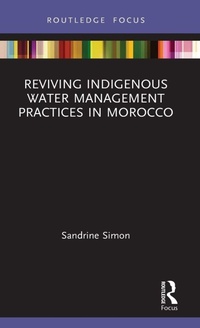
Reviving Indigenous Water Management Practices in Morocco
Alternative Pathways to Sustainable Development
1st Edition
Published on 16. March 2021
Book
Hardback
134 pages
978-0-367-61109-5 (ISBN)
Description
This book demonstrates how Morocco and other semi-arid countries can find solutions to water scarcity by rediscovering traditional methods of water resource management.
The book begins by examining indigenous water heritage, considering the contribution of Islam and the mixed influences of Greek and Roman, Middle Eastern, Andalusian and Berber cultures. It then provides a thorough examination of resource management practices in Morocco throughout history, tracing the changing patterns from the instillation of agrarian capitalism in the 19th century, through the Protectorate years (1912-1956), to the 21st century. The book explains how reviving and modernizing traditional methods of water management could provide simple, accessible, and successful methods for addressing 21st century challenges, such as water scarcity and climate change. The work concludes by highlighting how these indigenous practices might be used to provide real-world practical solutions for improving water governance and therefore developing sustainable water management practices.
Reviving Indigenous Water Management Practices in Morocco will be of great interest to students and scholars interested in water resource management, indigenous peoples, traditional knowledge, and sustainable development.
The book begins by examining indigenous water heritage, considering the contribution of Islam and the mixed influences of Greek and Roman, Middle Eastern, Andalusian and Berber cultures. It then provides a thorough examination of resource management practices in Morocco throughout history, tracing the changing patterns from the instillation of agrarian capitalism in the 19th century, through the Protectorate years (1912-1956), to the 21st century. The book explains how reviving and modernizing traditional methods of water management could provide simple, accessible, and successful methods for addressing 21st century challenges, such as water scarcity and climate change. The work concludes by highlighting how these indigenous practices might be used to provide real-world practical solutions for improving water governance and therefore developing sustainable water management practices.
Reviving Indigenous Water Management Practices in Morocco will be of great interest to students and scholars interested in water resource management, indigenous peoples, traditional knowledge, and sustainable development.
More details
Series
Language
English
Place of publication
London
United Kingdom
Publishing group
Taylor & Francis Ltd
Target group
Professional and scholarly
Dimensions
Height: 222 mm
Width: 145 mm
Thickness: 12 mm
Weight
326 gr
ISBN-13
978-0-367-61109-5 (9780367611095)
Copyright in bibliographic data and cover images is held by Nielsen Book Services Limited or by the publishers or by their respective licensors: all rights reserved.
Schweitzer Classification
Other editions
Additional editions
Sandrine Simon
Reviving Indigenous Water Management Practices in Morocco
Alternative Pathways to Sustainable Development
Book
05/2023
1st Edition
Routledge
€33.00
Shipment within 15-20 days
Sandrine Simon
Reviving Indigenous Water Management Practices in Morocco
Alternative Pathways to Sustainable Development
E-Book
03/2021
1st Edition
Routledge
€27.49
Available for download
Sandrine Simon
Reviving Indigenous Water Management Practices in Morocco
Alternative Pathways to Sustainable Development
E-Book
03/2021
1st Edition
Routledge
€27.49
Available for download
Person
Sandrine Simon holds a PhD in Ecological Economics from Keele University, UK. She has worked as a Research Fellow for Forum for the Future, lectured at the Open University, UK, at the Centre for Complexity and Change, and at the Euro-Mediterranean University of Fes, Morocco (UEMF). She is currently based as a researcher at the Interdisciplinary Research Centre for Education and Development (CeiED) of the Lusofona University of Lisbon, Portugal, where she focuses on urban agriculture, resilient cities, and territorial education.
Content
PART I Indigenous North African water heritage: a lesson in agro-ecology 1 Reviving indigenous water heritage; 2 A mixed heritage of traditional water management systems; PART II Paradigm shift: characteristics of "modern water management" in Morocco 3 Modernizing water management: a historical perspective; 4 Three key characteristics of Moroccan water management in the XXth c.; PART III New paths in water management: towards alternative development 5 Climate change, water stress, and the need for a new development paradigm; 6 Appropriate technologies: managing water scarcities in the XXIst c.; 7 Towards new forms of water governance; Conclusion: reviving practices, revaluing people