

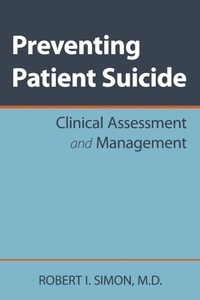
Preventing Patient Suicide
Clinical Assessment and Management
Published on 23. October 2010
Book
Paperback/Softback
235 pages
978-1-58562-934-3 (ISBN)
Description
Today's psychiatrists practice in an environment that poses
difficult challenges. Both treatment time and duration are limited by
insurance requirements; many facilities are understaffed; split treatment
arrangements are typical; and high-risk, acutely suicidal patients are
admitted to inpatient units for short lengths of stay. In addition, law now
plays a pervasive role in the practice of psychiatry. The doctor-patient
relationship is no longer defined solely by the involved parties. Clinicians
must juggle these requirements and limitations while providing the very best
care to their patients, especially those at high risk.
Preventing
Patient Suicide: Clinical Assessment and Management provides the
wisdom of Dr. Robert I. Simon's vast clinical experience, combined with the
latest insights from the evidence-based psychiatric literature, to offer a
cutting-edge survey of suicide prevention and management techniques. The author:
* Addresses sudden improvement in high-risk suicidal patients, a
phenomenon both common and perilous, with techniques for determining whether
the improvement is real or feigned.
* Explores in depth the misuse of
suicide risk assessment forms, with emphasis on their inherent
limitations.
* Examines the many entrenched myths and traditions about
suicide, exposing them to the critical light of evidence-based medicine,
including the concept of "imminent suicide risk" and the myth of "passive
suicide ideation".
* Discusses the continuum of chronic and acute
high-risk suicidal patients, the fluidity with which one can become the
other, and the difficulty in assessing these patients.
* Explores how
the law and psychiatry interact in frequently occurring clinical situations,
and the importance of therapeutic risk management.
In addition, the
book contains a variety of features that illuminate the subject and enhance
the reader's understanding, including:
* Inclusion of illustrative case studies, combined with commentary on
commonly occurring but complex clinical situations.
* Key points at the
end of each chapter that identify critical information.
* A Suicide
Risk Assessment Self-Test, a teaching instrument that consists of fifty
questions designed to enhance clinician suicide risk assessment by
incorporating evidence-based risk and protective factors.
Dr. Simon
provides a nuanced, empathic, yet pragmatic perspective on identifying,
assessing, and managing the suicidal patient while successfully navigating a
complex legal and clinical environment that poses its own risks to the
practitioner.
difficult challenges. Both treatment time and duration are limited by
insurance requirements; many facilities are understaffed; split treatment
arrangements are typical; and high-risk, acutely suicidal patients are
admitted to inpatient units for short lengths of stay. In addition, law now
plays a pervasive role in the practice of psychiatry. The doctor-patient
relationship is no longer defined solely by the involved parties. Clinicians
must juggle these requirements and limitations while providing the very best
care to their patients, especially those at high risk.
Preventing
Patient Suicide: Clinical Assessment and Management provides the
wisdom of Dr. Robert I. Simon's vast clinical experience, combined with the
latest insights from the evidence-based psychiatric literature, to offer a
cutting-edge survey of suicide prevention and management techniques. The author:
* Addresses sudden improvement in high-risk suicidal patients, a
phenomenon both common and perilous, with techniques for determining whether
the improvement is real or feigned.
* Explores in depth the misuse of
suicide risk assessment forms, with emphasis on their inherent
limitations.
* Examines the many entrenched myths and traditions about
suicide, exposing them to the critical light of evidence-based medicine,
including the concept of "imminent suicide risk" and the myth of "passive
suicide ideation".
* Discusses the continuum of chronic and acute
high-risk suicidal patients, the fluidity with which one can become the
other, and the difficulty in assessing these patients.
* Explores how
the law and psychiatry interact in frequently occurring clinical situations,
and the importance of therapeutic risk management.
In addition, the
book contains a variety of features that illuminate the subject and enhance
the reader's understanding, including:
* Inclusion of illustrative case studies, combined with commentary on
commonly occurring but complex clinical situations.
* Key points at the
end of each chapter that identify critical information.
* A Suicide
Risk Assessment Self-Test, a teaching instrument that consists of fifty
questions designed to enhance clinician suicide risk assessment by
incorporating evidence-based risk and protective factors.
Dr. Simon
provides a nuanced, empathic, yet pragmatic perspective on identifying,
assessing, and managing the suicidal patient while successfully navigating a
complex legal and clinical environment that poses its own risks to the
practitioner.
Reviews / Votes
Simon wades through the wealth of research on risk andprotective factors with impressive agility, providing a heuristic checklist
of individual, clinical, situational, interpersonal, and demographic factors
to assess. More than this, he highlights the central importance of the
therapeutic relationship as an agent of risk management and adaptive
change. -- Joseph J. Guido * PsycCRITIQUES * This book is an excellent source of information, not only
for those new to seeing patients in mental healthcare settings, but also for
veteran clinicians. Chapters are relatively brief, but contain volumes of
evidence-based data meant to improve a clinician's knowledge, with the added
benefit of improving patient safety. The chapter regarding suicide risk
assessment forms is vital, and the chapters outlining a complete suicide
risk assessment (i.e. including assessing positive factors against suicide
risk) are very well done. Overall, this is an outstanding book typical of
Dr. Simon's efforts. -- Steven T. Herron, M.D., * Doody's Publishers' Club * I have reviewed a number of Dr. Simon's books, at least a
few of which involve the topic of suicide (i.e.The American Psychiatric
Publishing Textbook of Suicide Assessment and Management (American
Psychiatric Publishing, 2006)), and this one is an excellent source of
information, not only for those new to seeing patients in mental healthcare
settings, but also for veteran clinicians. Chapters are relatively brief,
but contain volumes of evidence-based data meant to improve a clinician's
knowledge, with the added benefit of improving patient safety. The chapter
regarding suicide risk assessment forms is vital, and the chapters outlining
a complete suicide risk assessment (i.e. including assessing positive
factors against suicide risk) are very well done. Overall, this is an
outstanding book typical of Dr. Simon's efforts. -- Steven T Herron, MD(CPI/Assurance Health and Wellness * Doody *
More details
Language
English
Place of publication
VA
United States
Target group
Professional and scholarly
US School Grade: College Graduate Student and over
Product notice
Paperback (trade)
Illustrations
6 Line drawings, black and white; 16 Tables, unspecified
Dimensions
Height: 234 mm
Width: 154 mm
Thickness: 18 mm
Weight
395 gr
ISBN-13
978-1-58562-934-3 (9781585629343)
Copyright in bibliographic data and cover images is held by Nielsen Book Services Limited or by the publishers or by their respective licensors: all rights reserved.
Schweitzer Classification
Other editions
Additional editions
E-Book
08/2010
1st Edition
American Psychiatric Association Publishing
€48.99
Available for download
Person
Robert I. Simon, M.D., is Clinical Professor of
Psychiatry and Director of the Program in Psychiatry and Law in the
Department of Psychiatry at Georgetown University School of Medicine in
Washington, D.C. He is also Chairman of the Department of Psychiatry at
Suburban Hospital, Johns Hopkins Medicine, in Bethesda, Maryland.
Psychiatry and Director of the Program in Psychiatry and Law in the
Department of Psychiatry at Georgetown University School of Medicine in
Washington, D.C. He is also Chairman of the Department of Psychiatry at
Suburban Hospital, Johns Hopkins Medicine, in Bethesda, Maryland.
Content
Foreword
Preface
Acknowledgments
PART I:
ASSESSMENT
Chapter 1. Suicide Risk Assessment: A GATEWAY TO TREATMENT
AND MANAGEMENT
Chapter 2. Enhancing Suicide Risk Assessment Through
Evidence-Based Psychiatry
Chapter 3. Assessing and Enhancing Protective
Factors Against Suicide Risk
Chapter 4. Behavioral Risk Assessment of
the Guarded Suicidal Patient
Chapter 5. Psychiatric Disorders and
Suicide Risk
Chapter 6. Sudden Improvement in Patients at High Risk for
Suicide: REAL OR FEIGNED?
PART II: MANAGEMENT
Chapter 7. Patients at
Acute and Chronic High Risk for Suicide: CRISIS MANAGEMENT
Chapter 8.
Safety Management of the Patient at Risk for Suicide: COPING WITH
UNCERTAINTY
Chapter 9. Gun Safety Management of Suicidal Patients: A
COLLABORATIVE APPROACH
Chapter 10. Suicide Risk Assessment Forms:
CLINICIAN BEWARE
Chapter 11. Imminent Suicide, Passive Suicidal
Ideation, and Other Intractable Myths
Chapter 12. Quality Assurance
Review of Suicide Risk Assessments: REALITY AND REMEDY
Chapter 13.
Therapeutic Risk Management of the Patient at Risk for Suicide:
CLINICAL-LEGAL DILEMMAS
Appendix: Suicide Risk Assessment
Self-Test
Index
Preface
Acknowledgments
PART I:
ASSESSMENT
Chapter 1. Suicide Risk Assessment: A GATEWAY TO TREATMENT
AND MANAGEMENT
Chapter 2. Enhancing Suicide Risk Assessment Through
Evidence-Based Psychiatry
Chapter 3. Assessing and Enhancing Protective
Factors Against Suicide Risk
Chapter 4. Behavioral Risk Assessment of
the Guarded Suicidal Patient
Chapter 5. Psychiatric Disorders and
Suicide Risk
Chapter 6. Sudden Improvement in Patients at High Risk for
Suicide: REAL OR FEIGNED?
PART II: MANAGEMENT
Chapter 7. Patients at
Acute and Chronic High Risk for Suicide: CRISIS MANAGEMENT
Chapter 8.
Safety Management of the Patient at Risk for Suicide: COPING WITH
UNCERTAINTY
Chapter 9. Gun Safety Management of Suicidal Patients: A
COLLABORATIVE APPROACH
Chapter 10. Suicide Risk Assessment Forms:
CLINICIAN BEWARE
Chapter 11. Imminent Suicide, Passive Suicidal
Ideation, and Other Intractable Myths
Chapter 12. Quality Assurance
Review of Suicide Risk Assessments: REALITY AND REMEDY
Chapter 13.
Therapeutic Risk Management of the Patient at Risk for Suicide:
CLINICAL-LEGAL DILEMMAS
Appendix: Suicide Risk Assessment
Self-Test
Index