

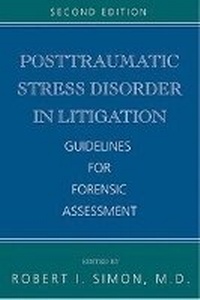
Posttraumatic Stress Disorder in Litigation
Guidelines for Forensic Assessment
2nd Edition
Published on 1. March 2004
Book
Hardback
272 pages
978-1-58562-066-1 (ISBN)
Description
The terrorist attacks on the World Trade Center in
September 2001 turned PTSD into a household word. But posttraumatic stress
disorder has been documented throughout history: For example, as long ago as
1666, Samuel Pepys wrote in his diary that he still had night terrors 6
months after the great fire of London. PTSD, officially recognized as a
diagnosis by DSM-III in 1980, is only the most recent term used to describe
the suffering of trauma victims.
Few could have foreseen its profound
impact on litigation. Often dubbed the "black hole" of litigation-where
allegations are relatively easy to assert but difficult to defend because
the symptoms are subjective-PTSD has deeply influenced civil and criminal
law in cases ranging from malpractice and personal injury to sexual
harassment and child abuse. It is thus vital for all legal parties involved
that forensic examiners perform credible psychiatric and psychological
examinations of PTSD claimants.
Intended to add direction and
discipline to the forensic assessment of PTSD litigants, this expanded
second edition begins with an updated chapter on current and future trends
for the role of PTSD in litigation.
* Chapter 2 notes the increasing evidence that exposure to multiple
events not only is more common than previously thought but also increases
the risk for development of PTSD following the target event.
* Chapter 3
details diagnostic criteria and guidelines for the forensic psychiatric
examination of the PTSD claimant.
* Most literature discusses PTSD in
adults. Chapter 4 offers a rare perspective on PTSD in children and
adolescents, including parental response to the trauma, developmental
effects, and delayed onset symptoms.
* Forensic assessment of PTSD
claimants is presented in Chapter 5, followed by new chapters on disability
determinants (how PTSD impairs occupational functioning) and PTSD in the
workplace, where the causal relationship between employment stress and a
resulting mental or emotional disorder must be determined.
* Chapter 8
covers guidelines for malingering in PTSD, where the claimant may be
motivated by financial gain or by a reduced charge resulting from an
insanity defense.
* A new chapter on forensic laboratory testing in PTSD
presents the tantalizing potential of psychophysiologic measurement to
redeem the PTSD diagnosis from its daunting subjectivity.
This
essential collection by 13 U.S. experts sheds important new light on
forensic guidelines for effective assessment and diagnosis and determination
of disability, serving both plaintiffs and defendants in litigation
involving PTSD claims. Mental health and legal professionals, third-party
payers, and interested laypersons will welcome this balanced approach to a
complex and difficult field.
September 2001 turned PTSD into a household word. But posttraumatic stress
disorder has been documented throughout history: For example, as long ago as
1666, Samuel Pepys wrote in his diary that he still had night terrors 6
months after the great fire of London. PTSD, officially recognized as a
diagnosis by DSM-III in 1980, is only the most recent term used to describe
the suffering of trauma victims.
Few could have foreseen its profound
impact on litigation. Often dubbed the "black hole" of litigation-where
allegations are relatively easy to assert but difficult to defend because
the symptoms are subjective-PTSD has deeply influenced civil and criminal
law in cases ranging from malpractice and personal injury to sexual
harassment and child abuse. It is thus vital for all legal parties involved
that forensic examiners perform credible psychiatric and psychological
examinations of PTSD claimants.
Intended to add direction and
discipline to the forensic assessment of PTSD litigants, this expanded
second edition begins with an updated chapter on current and future trends
for the role of PTSD in litigation.
* Chapter 2 notes the increasing evidence that exposure to multiple
events not only is more common than previously thought but also increases
the risk for development of PTSD following the target event.
* Chapter 3
details diagnostic criteria and guidelines for the forensic psychiatric
examination of the PTSD claimant.
* Most literature discusses PTSD in
adults. Chapter 4 offers a rare perspective on PTSD in children and
adolescents, including parental response to the trauma, developmental
effects, and delayed onset symptoms.
* Forensic assessment of PTSD
claimants is presented in Chapter 5, followed by new chapters on disability
determinants (how PTSD impairs occupational functioning) and PTSD in the
workplace, where the causal relationship between employment stress and a
resulting mental or emotional disorder must be determined.
* Chapter 8
covers guidelines for malingering in PTSD, where the claimant may be
motivated by financial gain or by a reduced charge resulting from an
insanity defense.
* A new chapter on forensic laboratory testing in PTSD
presents the tantalizing potential of psychophysiologic measurement to
redeem the PTSD diagnosis from its daunting subjectivity.
This
essential collection by 13 U.S. experts sheds important new light on
forensic guidelines for effective assessment and diagnosis and determination
of disability, serving both plaintiffs and defendants in litigation
involving PTSD claims. Mental health and legal professionals, third-party
payers, and interested laypersons will welcome this balanced approach to a
complex and difficult field.
Reviews / Votes
This book is a welcome update to the first edition andprovides readers with a thorough, well balanced, and comprehensive view of
forensic assessment of individuals claiming psychiatric difficulty secondary
to PTSD. The authors are well known and experienced in their respective
fields, and are able to relate important and complicated issues in a
relevant, easy to understand manner. This work also provides readers with
essential guidelines and encourages a scientific approach for the assessment
of these complex legal cases. In their attempt to raise the bar for forensic
practitioners, the authors provide an invaluable resource for mental health
and legal professionals involved in PTSD evaluation and litigation. An
extensive list of references at the end of each chapter also provides the
reader with links to further relevant information for those interested in
exploring the topic in more depth. -- Steven T. Herron, M.D. * Doody's Health Science Review * A vital resource for any forensics expert who testifies in
court to understand lines of questioning by attorneys, as well as for
psychological forensics experts who must perform retrospective psychological
analyses. -- J. A. Brown, Education America * CHOICE Magazine * The book includes a thorough analysis of the problem areas
in the forensic assessment of PTSD litigants. The guidelines proposed in
each chapter are practical and clearly written. This book is recommended for
both clinicians and attorneys who work in the area of PTSD litigation. * Psychiatric Services *
More details
Edition
Second Edition
Language
English
Place of publication
VA
United States
Target group
College/higher education
Professional and scholarly
US School Grade: College Graduate Student and over
Edition type
Revised edition
Product notice
Laminated cover
Illustrations
Not illustrated
Dimensions
Height: 216 mm
Width: 147 mm
Thickness: 22 mm
Weight
562 gr
ISBN-13
978-1-58562-066-1 (9781585620661)
Copyright in bibliographic data and cover images is held by Nielsen Book Services Limited or by the publishers or by their respective licensors: all rights reserved.
Schweitzer Classification
Other editions
Additional editions
Robert I. Simon
Posttraumatic Stress Disorder in Litigation, Second Edition
Guidelines for Forensic Assessment
E-Book
08/2008
1st Edition
American Psychiatric Publishing
€83.79
Available for download
Previous edition

Book
01/1995
American Psychiatric Press Inc.
€43.51
Article exhausted; check for reprint
Person
Robert I. Simon, M.D., is Clinical Professor of
Psychiatry and Director of the Program in Psychiatry and the Law at
Georgetown University School of Medicine in Washington, D.C.
Psychiatry and Director of the Program in Psychiatry and the Law at
Georgetown University School of Medicine in Washington, D.C.
Content
Contributors
Foreword
Preface
Acknowledgments
Introduction
Chapter
1. Persistent Reexperiences in Psychiatry and Law: Current and Future Trends
for the Role of PTSD in Litigation
Chapter 2. Recent Research Findings
on the Diagnosis of PTSD: Prevalence, Course, Comorbidity, and
Risk
Chapter 3. Forensic Psychiatric Assessment of PTSD
Claimants
Chapter 4. PTSD in Children and Adolescents: An Overview With
Guidelines for Forensic Assessment
Chapter 5. Forensic Psychological
Assessment in PTSD
Chapter 6. Disability Determination in PTSD
Litigation
Chapter 7. PTSD in Employment Litigation
Chapter 8.
Guidelines for Evaluation of Malingering in PTSD
Chapter 9. Forensic
Laboratory Testing for PTSD
Index
Foreword
Preface
Acknowledgments
Introduction
Chapter
1. Persistent Reexperiences in Psychiatry and Law: Current and Future Trends
for the Role of PTSD in Litigation
Chapter 2. Recent Research Findings
on the Diagnosis of PTSD: Prevalence, Course, Comorbidity, and
Risk
Chapter 3. Forensic Psychiatric Assessment of PTSD
Claimants
Chapter 4. PTSD in Children and Adolescents: An Overview With
Guidelines for Forensic Assessment
Chapter 5. Forensic Psychological
Assessment in PTSD
Chapter 6. Disability Determination in PTSD
Litigation
Chapter 7. PTSD in Employment Litigation
Chapter 8.
Guidelines for Evaluation of Malingering in PTSD
Chapter 9. Forensic
Laboratory Testing for PTSD
Index