

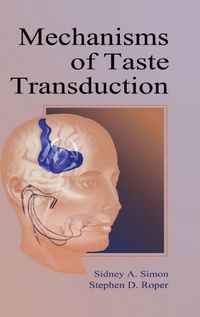
Mechanisms of Taste Transduction
1st Edition
Published on 23. July 1993
Book
Hardback
526 pages
978-0-8493-5341-3 (ISBN)
Description
Mechanisms of Taste Transduction introduces a number of topics essential to a complete understanding of taste. These topics range from the control of food intake to the biophysical mechanisms of transduction and the design of food flavors in the food industry. The responses and organization of special sensory pathways are described in regard to their development, morphology, composition, electrophysiological and biochemical responses. Details are presented at several levels to appeal to researchers in molecular biology, membrane biophysics, human psychophysics, neuroanatomy, and chemistry. Current research is described in the context of what preceding studies have revealed, and the chapter authors are among today's most active and highly respected researchers in the field of chemical senses.
More details
Language
English
Place of publication
Bosa Roca
United States
Publishing group
Taylor & Francis Inc
Target group
College/higher education
Professional and scholarly
Professional
Illustrations
6 s/w Tabellen
6 Tables, black and white
Dimensions
Height: 240 mm
Width: 161 mm
Thickness: 33 mm
Weight
948 gr
ISBN-13
978-0-8493-5341-3 (9780849353413)
Copyright in bibliographic data and cover images is held by Nielsen Book Services Limited or by the publishers or by their respective licensors: all rights reserved.
Schweitzer Classification
Other editions
Additional editions
Sidney A. Simon | Stephen D. Roper
Mechanisms of Taste Transduction
Book
06/2020
1st Edition
CRC Press
€96.20
Shipment within 15-20 days
Sidney A. Simon | Stephen D. Roper
Mechanisms of Taste Transduction
E-Book
07/2014
1st Edition
CRC Press
€86.99
Available for download
Sidney A. Simon | Stephen D. Roper
Mechanisms of Taste Transduction
E-Book
07/2014
CRC Press
€86.99
Available for download
Persons
Simon\, Sidney A.; Roper\, Stephen D.
Content
Part I: Food Intake 1. The Role of Taste in Food Intake: A Comparative View Part II: Morphology of Taste Receptors 2. Morphology of Vertebrate Taste Organs and Their Nerve Supply 3. The General Somatic Afferent Terminals in Oral Mucosae Part III:Development of Peripheral Taste System 4. Control Mechanisms in Taste Bud Development 5. The Developing Gustatory System: Function, Morphological, and Behavioral Perspectives Part IV:Transduction Mechanisms 6. Peripheral Transduction Mechanisms 7. The Molecular Biology of Chemotransduction 8. Cell Biology of the Lingual Epithelium 9. Chemical Responses of Lingual Nerves and Lingual Epithelia 10. Genetic and Neurobehavioral Approaches to the Taste Receptor Mechanism in Mammals Part V:Coding 11. Synaptic Interactions in Taste Buds 12. Sensory Coding by Peripheral Taste Fibers 13. Orosensory Processing in Neural Systems of the Nucleus of the Solitary Tract 14. Psychophysics: Insights into Transduction Mechanisms and Neural Coding Part VI: Designing Tastants and Foods 15. Molecular Modeling Studies of Amiloride Analogs 16. Design of Sweet and Bitter Tastants 17. Design of New Foods