

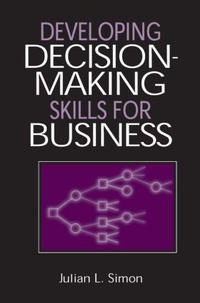
Developing Decision-Making Skills for Business
1st Edition
Published on 30. September 2000
Book
Hardback
229 pages
978-0-7656-0676-1 (ISBN)
Description
This practical resource shows business professionals how to improve their decision-making skills and enhance their ability to develop effective interpersonal relationships with co-workers and clients. The book covers a wide range of topics -- identifying tastes and preferences, personal skill assessment, cost-benefit analysis, risk and uncertainty, multi-tasking, human resource management, time constraints, data collection, and more. Designed to help busy professionals make the most effective use of time and energy, it will also be useful in the study of organizational behavior and business psychology.
More details
Language
English
Place of publication
London
United Kingdom
Publishing group
Taylor & Francis Ltd
Target group
Professional and scholarly
Dimensions
Height: 229 mm
Width: 152 mm
Weight
453 gr
ISBN-13
978-0-7656-0676-1 (9780765606761)
Copyright in bibliographic data and cover images is held by Nielsen Book Services Limited or by the publishers or by their respective licensors: all rights reserved.
Schweitzer Classification
Other editions
Additional editions
Julian Lincoln Simon
Developing Decision-Making Skills for Business
E-Book
07/2016
Routledge
€311.99
Available for download
Julian Lincoln Simon
Developing Decision-Making Skills for Business
E-Book
07/2016
Routledge
€311.99
Available for download
Person
Julian L. Simon
Content
Part I Wants, Abilities, and Goals; Chapter 1 Tastes, Preferences, Wants, and Values; Chapter 2 Assessing Your Resources; Chapter 3 Choosing Goals and Criteria of Success; Part II Introduction to Evaluative Thinking; Chapter 4 Evaluating Simple Alternatives; Chapter 5 Weighing Present Versus Future Benefits (and Costs); Chapter 6 How to Think About Cost; Chapter 7 Allowing for Uncertainty; Chapter 8 Dealing With Risks; Chapter 9 Reconciling Multiple Goals; Part III Getting Useful Ideas and Knowledge; Chapter 10 Getting and Eliminating Ideas; Chapter 11 Experts, Expert Systems, and Libraries; Chapter 12 Using Scientific Discipline to Obtain Information; Chapter 13 Assessing Consequences and Likelihoods; Part IV Working With Information and Knowledge; Chapter 14 Pitfalls That Entrap Our Thinking; Chapter 15 My Favorite Worst Sources of Errors; Chapter 16 Good Judgment; Chapter 17 Self-Discipline and Habits of Thought; Chapter 18 Dealing With People, and Managing Them;