

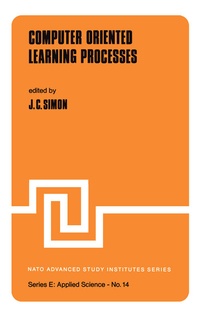
Computer Oriented Learning Processes
Will be published approx. on 31. August 1976
Book
Hardback
601 pages
978-90-286-0475-9 (ISBN)
More details
Series
Edition
1976 edition
Language
English
Place of publication
Dordrecht
Netherlands
Publishing group
Springer
Target group
Professional and scholarly
Research
Product notice
sewn/stitched
Cloth over boards
Illustrations
601 p.
Dimensions
Height: 0 mm
Width: 0 mm
Weight
1200 gr
ISBN-13
978-90-286-0475-9 (9789028604759)
DOI
10.1007/978-94-010-1545-5
Schweitzer Classification
Other editions
Additional editions
J.C. Simon
Computer Oriented Learning Processes
Book
11/2011
Springer
€53.49
Shipment within 15-20 days
Content
A Review of Computer Oriented Learning Processes/Une revue des procédures informatiques dites d'apprentissage.- 1. Adaptive Numerical Processes.- Modèles d'apprentissage.- 2. The Stochastic Automata.- Learning with Stochastic Automata and Stochastic Languages.- Learning in Fuzzy Machines.- Learning Decision-making with Fuzzy Automata.- 3. Inference of Formal Grammars.- Some Experiments in Grammatical Inference.- Non-counting Languages and Learning.- Grammatical Inference on Natural Language Samples in the Framework.- Natural Language Acquisition by Robot.- A System Able to Learn a Language as a Model of Intelligence.- 4. Pattern Recognition.- Generation of Recognition Operators by Stochastic and Heuristic Learning.- Entropie quadratique et reconnaissance des formes.- Etude de diverses heuristiques pour des processus d'interrogation.- Feature Selection Using Mutual Information.- Apprentissage et mesures de ressemblances adaptatives.- Learning by Inductive Inference.- 5. Learning to Play a Game.- Learning to Solve Games and Puzzles.- Additive Features in Positional Games.- Realization of a Program Learning to Find Combinations at Chess.- 6. Robotics and Problem Solving.- Procedural Learning in Worlds of Robots.- Automatic Synthesis of SNOBOL Programs.- Design of an Interactive Environment to Study the Behaviour of Several Robots Which Can Learn, Plan Their Actions and Coexist.- A General Approach to Learning in Problem Solving.- Project of a System Learning a Goal Oriented Behaviour.- 7. Interactive Model Formation by Inductive Inference.- Scientific Theory Formation by Computer.- Planning Paradigms: Knowledge for Organizing Models into Programs.- Semantic Memory and Procedural Learning.- Empirical Prediction Algorithms.- List of Participants.