

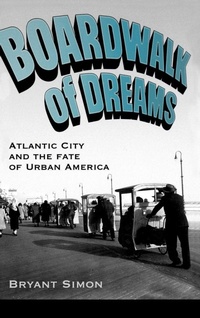
Boardwalk of Dreams
Atlantic City and the Fate of Urban America
Published on 19. August 2004
Book
Hardback
304 pages
978-0-19-516753-5 (ISBN)
Description
During the first half of the twentieth century, Atlantic City was the nation's most popular middle-class resort--the home of the famed Boardwalk, the Miss America Pageant, and the board game Monopoly. By the late 1960s, it had become a symbol of urban decay and blight, compared by journalists to bombed-out Dresden and war-torn Beirut. Several decades and a dozen casinos later, Atlantic City is again one of America's most popular tourist spots, with thirty-five million visitors a year. Yet most stay for a mere six hours, and the highway has replaced the Boardwalk as the city's most important thoroughfare. Today the city doesn't have a single movie theater and its one supermarket is a virtual fortress protected by metal detectors and security guards.
In this wide-ranging book, Bryant Simon does far more than tell a nostalgic tale of Atlantic City's rise, near death, and reincarnation. He turns the depiction of middle-class vacationers into a revealing discussion of the boundaries of public space in urban America. In the past, he argues, the public was never really about democracy, but about exclusion. During Atlantic City's heyday, African Americans were kept off the Boardwalk and away from the beaches. The overly boisterous or improperly dressed were kept out of theaters and hotel lobbies by uniformed ushers and police. The creation of Atlantic City as the "Nation's Playground" was dependent on keeping undesirables out of view unless they were pushing tourists down the Boardwalk on rickshaw-like rolling chairs or shimmying in smoky nightclubs.
Desegregation overturned this racial balance in the mid-1960s, making the city's public spaces more open and democratic, too open and democratic for many middle-class Americans, who fled to suburbs and suburban-style resorts like Disneyworld. With the opening of the first casino in 1978, the urban balance once again shifted, creating twelve separate, heavily guarded, glittering casinos worlds walled off from the dilapidated houses, boarded-up businesses, and lots razed for redevelopment that never came. Tourists are deliberately kept away from the city's grim reality and its predominantly poor African American residents. Despite ten of thousands of buses and cars rolling into every day, gambling has not saved Atlantic City or returned it to its glory days.
Simon's moving narrative of Atlantic City's past points to the troubling fate of urban America and the nation's cultural trajectory in the twentieth century, with broad implications for those interested in urban studies, sociology, planning, architecture, and history.
In this wide-ranging book, Bryant Simon does far more than tell a nostalgic tale of Atlantic City's rise, near death, and reincarnation. He turns the depiction of middle-class vacationers into a revealing discussion of the boundaries of public space in urban America. In the past, he argues, the public was never really about democracy, but about exclusion. During Atlantic City's heyday, African Americans were kept off the Boardwalk and away from the beaches. The overly boisterous or improperly dressed were kept out of theaters and hotel lobbies by uniformed ushers and police. The creation of Atlantic City as the "Nation's Playground" was dependent on keeping undesirables out of view unless they were pushing tourists down the Boardwalk on rickshaw-like rolling chairs or shimmying in smoky nightclubs.
Desegregation overturned this racial balance in the mid-1960s, making the city's public spaces more open and democratic, too open and democratic for many middle-class Americans, who fled to suburbs and suburban-style resorts like Disneyworld. With the opening of the first casino in 1978, the urban balance once again shifted, creating twelve separate, heavily guarded, glittering casinos worlds walled off from the dilapidated houses, boarded-up businesses, and lots razed for redevelopment that never came. Tourists are deliberately kept away from the city's grim reality and its predominantly poor African American residents. Despite ten of thousands of buses and cars rolling into every day, gambling has not saved Atlantic City or returned it to its glory days.
Simon's moving narrative of Atlantic City's past points to the troubling fate of urban America and the nation's cultural trajectory in the twentieth century, with broad implications for those interested in urban studies, sociology, planning, architecture, and history.
Reviews / Votes
Boardwalk of Dreams is passionately argued, and Simon writes of his own personal connection to Atlantic City with sincerity but not sentimentality....This is a very entertaining read * Urban History Review * Perhaps the finest book ever written about Atlantic City, an...incisive history of the tension between the 'resort' and the less-glitzy urban reality tourists rush past. * The Philadelphia Inquirer * A gifted writer as well as a clear-eyed historian, Simon moves effortlessly in Boardwalk of Dreams between the fantasies that Atlantic City sold and the social, economic and political worlds that underlay them. The result is a lively, evocative, eminently readable book that looks beyond the Jersey beach town to the inner pulse of urban America. * The Chicago Tribune * Professor Bryant is onto something here, and it is refreshing...a sober look at urban degeneration and regeneration against the backdrop of a changing nation enjoying its post-World War II prosperity, and a burgeoning middle class eager to parade its riches on the Boardwalk. * The New York Times *More details
Language
English
Place of publication
New York
United States
Target group
Professional and scholarly
Urban History
Illustrations
14 Fotos bzw. Rasterbilder, 1 Karte
14 halftones, 1 map
Dimensions
Height: 235 mm
Width: 157 mm
Thickness: 22 mm
Weight
644 gr
ISBN-13
978-0-19-516753-5 (9780195167535)
Copyright in bibliographic data and cover images is held by Nielsen Book Services Limited or by the publishers or by their respective licensors: all rights reserved.
Schweitzer Classification
Other editions
Additional editions
Book
05/2006
Oxford University Press Inc
€46.20
Shipment within 15-20 days
E-Book
07/2004
1st Edition
OUP eBook
€19.99
Available for download
E-Book
07/2004
OUP eBook
€15.49
Available for download
Person
Bryant Simon is Associate Professor of History at the University of Georgia. He is the author of A Fabric of Defeat: The Politics of South Carolina Millhands, 1910-1948 and co-editor of 'Jumpin Jim Crow': Southern Politics from Civil War to Civil Rights. He grew up in southern New Jersey.
Content
Preface
Introduction
1. Staging Utopia on the Boardwalk:
2. The Midway:
3. Mapping Atlantic City:
4. The Last Picture Shows:
5. Narrating Decline and Erasing Race:
6. Rebuilding the Crowd:
7. Life in the Dying City:
8. Disneyland and the Devil's Bargain:
9. Casino Publics:
Epilogue
Introduction
1. Staging Utopia on the Boardwalk:
2. The Midway:
3. Mapping Atlantic City:
4. The Last Picture Shows:
5. Narrating Decline and Erasing Race:
6. Rebuilding the Crowd:
7. Life in the Dying City:
8. Disneyland and the Devil's Bargain:
9. Casino Publics:
Epilogue