

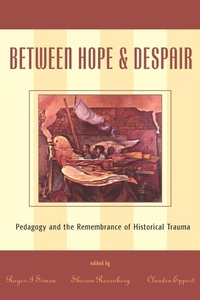
Between Hope and Despair
Pedagogy and the Remembrance of Historical Trauma
Published on 15. March 2000
Book
Paperback/Softback
264 pages
978-0-8476-9463-1 (ISBN)
Description
At the end of a century of unfathomable suffering, societies are facing anew the question of how events that shock, resist assimilation, and evoke contradictory and complex responses should be remembered. Between Hope and Despair specifically examines the pedagogical problem of how remembrance is to proceed when what is to be remembered is underscored by a logic difficult to comprehend and subversive of the humane character of existence. This pedagogical attention to practices of remembrance reflects the growing cognizance that hope for a just and compassionate future lies in the sustained, if troubled, working through of these issues.
Reviews / Votes
This is a book that is at once masterful, disturbing, and passionate. The scholarship is meticulous and the analysis penetrating and insightful. The writers challenge us all to confront the enormity of evil as well as to celebrate the profoundly human impulse for redemption. -- David E. Purpel, University of North Carolina, Greensboro These wide-ranging, courageous essays on the impact of the Holocaust, the Rwandan genocide and other instances of political terror and mass violence, acknowledge the limits of the social and psychological remedies that can be drawn from remembering the past. At the same time, through a close and intensive study of testimonies, memoirs, fiction (including second-generation witness), and other modes of story telling they scrupulously analyze the possibility of working-through recent trauma. The essayists jointly advocate a new direction, which they call the pedagogical rather than strategic practice of memorialization. -- Geoffrey Hartman, Project Director, Fortunoff Video Archive for Holocaust Testimonies, Yale University Between Hope and Despair is a well-documented, scholarly work. . . . The editors of [the book] should indeed be commended for offering us such a wonderful collection. * Journal Of Curriculum Studies * An exceptionally smart collection of essays. * Jac * Shoshana Felman observed that the unprecedented teaching possibilities opened up by the 'revolutionary pedagogy of psychoanalysis' have never been fully grasped or utilized in the classroom. The contributors to this collection and other educators now exploring the relations between history, trauma, and teaching, have begun that work. Their efforts lay the groundwork for nothing less than a fundamental rethinking of 'multicultural education' and teaching about and across social and cultural difference. -- Elizabeth Ellsworth, Department of Curriculum and Instruction, University of Wisconsin, MadisonMore details
Series
Language
English
Place of publication
United States
Publishing group
Bloomsbury Publishing Plc
Dimensions
Height: 229 mm
Width: 152 mm
Thickness: 16 mm
Weight
434 gr
ISBN-13
978-0-8476-9463-1 (9780847694631)
Copyright in bibliographic data and cover images is held by Nielsen Book Services Limited or by the publishers or by their respective licensors: all rights reserved.
Schweitzer Classification
Other editions
Additional editions
Claudia Eppert | Roger I. Simon | Sharon Rosenberg
Between Hope and Despair
Pedagogy and the Remembrance of Historical Trauma
E-Book
03/2000
1st Edition
Bloomsbury eBooks US
€44.99
Available for download
Roger I. Simon | Sharon Rosenberg | Claudia Eppert
Between Hope and Despair
Pedagogy and the Remembrance of Historical Trauma
E-Book
03/2000
1st Edition
Rowman & Littlefield Publishers
from
€59.09
Available for download
Persons
Roger I. Simon teaches at the Ontario Institute for Studies in Education at the University of Toronto. He has written extensively in the area of critical pedagogy and cultural studies and is the author of Teaching Against the Grain: Texts for a Pedagogy of Possibility.
Sharon Rosenberg is assistant professor at York University in Toronto, where she teaches in the School of Women's Studies. Her scholarly work attends to questions of feminist remembrance practice in the wake of ongoing traumatic violences against women.
Claudia Eppert recently completed her doctoral disseration at the Ontario Institute for Studies in Education/ University of Toronto. Her work focuses on the ethico-pedagogical possibilities for a responsive/responsible practice of reading contemporary literature of historical witness.
Sharon Rosenberg is assistant professor at York University in Toronto, where she teaches in the School of Women's Studies. Her scholarly work attends to questions of feminist remembrance practice in the wake of ongoing traumatic violences against women.
Claudia Eppert recently completed her doctoral disseration at the Ontario Institute for Studies in Education/ University of Toronto. Her work focuses on the ethico-pedagogical possibilities for a responsive/responsible practice of reading contemporary literature of historical witness.
Content
Chapter 1 Introduction: Between Hope and Despair: The Pedagogical Encounter of Historical Rememberance
Chapter 2 1 The Paradoxical Practice of Zakhor: "Memories of That Which Has Never My Fault"
Chapter 3 2 If the Story Cannot End: Deferred Action, Ambivalence and Difficult Knowledge
Chapter 4 3 Anxiety and Contact in Attending to a Play about Landmines
Chapter 5 4 Standing in a Circle of Stone: Rupturing the Binds of Emblamatic Memory
Chapter 6 5 Never to Forget: Pedagogical Memory and Second Generation Witness
Chapter 7 6 Artifactual Testimonies and the Staging of Holocaust Memories
Chapter 8 7 Pedagogy and Trauma: The Middle
Passage, Slavery, and the Problem of Creolization
Chapter 9 8 Loss in Present Terms: Reading the Limits of Post-dictatorship Argentina's National Conciliation
Chapter 10 9 Beyond Reconciliation: Memory and Allerity in Post-Genocide Rwanda
Chapter 11 10 Re-Learning Questions: Responses to the Ethical Address of the Past and Present of Others
Chapter 12 Bibliography
Chapter 13 Index
Chapter 14 About the Editors and Contributors
Chapter 2 1 The Paradoxical Practice of Zakhor: "Memories of That Which Has Never My Fault"
Chapter 3 2 If the Story Cannot End: Deferred Action, Ambivalence and Difficult Knowledge
Chapter 4 3 Anxiety and Contact in Attending to a Play about Landmines
Chapter 5 4 Standing in a Circle of Stone: Rupturing the Binds of Emblamatic Memory
Chapter 6 5 Never to Forget: Pedagogical Memory and Second Generation Witness
Chapter 7 6 Artifactual Testimonies and the Staging of Holocaust Memories
Chapter 8 7 Pedagogy and Trauma: The Middle
Passage, Slavery, and the Problem of Creolization
Chapter 9 8 Loss in Present Terms: Reading the Limits of Post-dictatorship Argentina's National Conciliation
Chapter 10 9 Beyond Reconciliation: Memory and Allerity in Post-Genocide Rwanda
Chapter 11 10 Re-Learning Questions: Responses to the Ethical Address of the Past and Present of Others
Chapter 12 Bibliography
Chapter 13 Index
Chapter 14 About the Editors and Contributors