

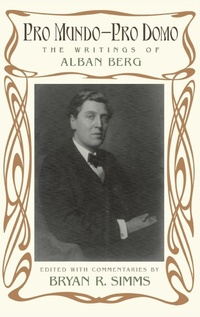
Pro Mundo - Pro Domo
The Writings of Alban Berg
Published on 27. March 2014
Book
Hardback
464 pages
978-0-19-976406-8 (ISBN)
Description
Pro Mundo - Pro Domo: The Writings of Alban Berg contains new English translations of the complete writings of the Viennese composer Alban Berg (1885-1935) and extensive commentaries tracing the history of each essay and its connection to musical culture of the early twentieth century. Berg is now recognized as a classic composer of the modern period, best known for his operas Wozzeck and Lulu. Berg, Anton Webern, and their teacher Arnold Schoenberg constitute the "Second Viennese School" which played a major role in the transformation of serious music as it entered the modern period.
Berg was an avid and skillful writer. His essays include analytic studies of compositions by Schoenberg, polemics on music and musicians of his day, and lectures and miscellaneous writings on a variety of topics. Throughout his considerable and diverse corpus of writings, Berg alternates between two perspectives: Pro Mundo - Pro Domo, meaning roughly "speaking for all - speaking for myself" commenting at one moment on the general state of culture and the world, and the next moment on his own works. In his early years he also tried his hand at fictional writing, using works by Ibsen and Strindberg as models. This new English edition contains 47 essays, many of which are little known and have not been previously available in English.
Berg was an avid and skillful writer. His essays include analytic studies of compositions by Schoenberg, polemics on music and musicians of his day, and lectures and miscellaneous writings on a variety of topics. Throughout his considerable and diverse corpus of writings, Berg alternates between two perspectives: Pro Mundo - Pro Domo, meaning roughly "speaking for all - speaking for myself" commenting at one moment on the general state of culture and the world, and the next moment on his own works. In his early years he also tried his hand at fictional writing, using works by Ibsen and Strindberg as models. This new English edition contains 47 essays, many of which are little known and have not been previously available in English.
Reviews / Votes
Absolutely necessary reading for expert and student alik? * a most significant addition to the literature.CHOICE *More details
Language
English
Place of publication
New York
United States
Target group
College/higher education
Professional and scholarly
Illustrations
9 halftones, 369 music examples
Dimensions
Height: 240 mm
Width: 161 mm
Thickness: 29 mm
Weight
854 gr
ISBN-13
978-0-19-976406-8 (9780199764068)
Copyright in bibliographic data and cover images is held by Nielsen Book Services Limited or by the publishers or by their respective licensors: all rights reserved.
Schweitzer Classification
Other editions
Additional editions
Book
05/2017
Oxford University Press Inc
€63.40
Shipment within 15-20 days
E-Book
03/2017
OUP eBook
€18.49
Available for download
E-Book
01/2014
1st Edition
OUP eBook
€21.99
Available for download
Person
Bryan R. Simms is Professor in the Thornton School of Music at the University of Southern California. He was formerly editor of the Journal of Music Theory and Music Theory Spectrum, and he has served on the Council of the American Musicological Society and Executive Board of the Society for Music Theory. He specializes in music and musical theory of the 20th century, and his books include most recently The Atonal Music of Arnold Schoenberg: 1908-1923, Music in Western Civilization, and Alban Berg: A Research and Information Guide, second edition.
Content
Introduction ; THE SCHOENBERG GUIDES ; Arnold Schoenberg, Gurrelieder: Guide ; Arnold Schoenberg, Chamber Symphony, Op. 9: Thematic Analysis ; Pelleas and Melisande (after the drama by Maurice Maeterlinck). Symphonic Poem for Orchestra, by Arnold Schoenberg, Op. 5: Thematic Analysis ; Pelleas and Melisande (after the drama by Maurice Maeterlinck). Symphonic Poem for Orchestra, by Arnold Schoenberg, Op. 5: Brief Thematic Analysis ; Commentary on the Schoenberg Guides ; ESSAYS, LECTURES, AND ANALYSES ; The Musical Impotence of Hans Pfitzner's Die neue Aesthetik ; Vienna's Music Criticism: Two Feuilletons ; The Musical Forms in My Opera Wozzeck ; Why Is Schoenberg's Music So Difficult to Understand? ; Alban Berg's Chamber Concerto: An Open Letter ; Committed Response to a Noncommittal Survey ; Two Analyses of the Lyric Suite ; Composition with Twelve Tones ; Nine Pages on the Lyric Suite ; Introducing Ernst Krenek ; The "Problem of Opera": Pro Mundo - Pro Domo ; Voice in Opera ; What Is Atonal? A Dialog ; Lecture on Wozzeck: The "Atonal Opera" ; Credo ; A Few Remarks on Staging the Opera Wozzeck ; Commemorative Address for Emil Hertzka ; Commentary on Essays, Lectures, and Analyses ; TRIBUTES ; The Teacher ; On Willem Mengelberg and the Concertgebouw Orchestra ; On the Hundredth Anniversary of Franz Schubert's Death ; For Adolf Loos: Double Acrostic Distich for the Tenth of December ; On Winfried Zillig ; To Karl Kraus ; Handel and Bach ; Faith, Hope, and Love: For Schoenberg's Sixtieth Birthday ; Commentary on Tributes ; INTERVIEWS ; With the Composer of Wozzeck: A Conversation with Alban Berg, by Carl Marilaun ; A Chat with Alban Berg, by Oskar Baum ; Conversation with Alban Berg: Impressions from a Wozzeck Performance in Leningrad, by "Iron" ; A Conversation with Alban Berg, by Oskar Jancke ; Critique of the Critique: Conversation with Alban Berg and Clemens Krauss, by Otto Konig ; "We spoke today with Alban Berg... " ; Commentary on Interviews ; FICTIONAL WORKS ; Hanna ; A Mining Drama ; Night (Nocturne): Preliminary Plan, Notes for the Monodrama ; Commentary on Fictional Works ; MISCELLANEOUS WRITINGS ; An Appeal for Schoenberg ; On Mahler's Ninth Symphony ; Two Prospectuses for the Society for Private Musical Performances ; Letter from Vienna ; Questions About Jazz ; Opera Theater ; On Reopening the Vienna Volksoper ; Should Wagner Stagings Be Modernized? ; On Composition with Twelve-Tone Rows ; Commentary on Miscellaneous Writings