

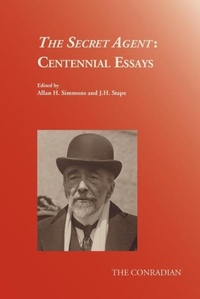
The Secret Agent
Centennial Essays
Published on 1. January 2007
Book
Paperback/Softback
196 pages
978-90-420-2176-1 (ISBN)
Description
This collection of thirteen essays by writers from several countries lavishly celebrates the centenary of the publication of Conrad's The Secret Agent. It reconsiders one of Conrad's most important political novels from a variety of critical perspectives and presents a stimulating documentary section as well as specially commissioned maps and new contextualizing illustrations. Much new information is provided on the novel's sources, and the work is placed in new several contexts. The volume is essential reading on this novel both for students studying it as a set text as well as for scholars of the late-Victorian and early Modernist periods.
More details
Series
Language
English
Place of publication
Leiden
Netherlands
Publishing group
Brill
Product notice
Paperback (trade)
Unsewn / adhesive bound
Dimensions
Height: 234 mm
Width: 155 mm
Thickness: 12 mm
Weight
286 gr
ISBN-13
978-90-420-2176-1 (9789042021761)
Copyright in bibliographic data and cover images is held by Nielsen Book Services Limited or by the publishers or by their respective licensors: all rights reserved.
Schweitzer Classification
Content
Foreword
Contributors
David MULRY: The Anarchist in the House: The Politics of Conrad's The Secret Agent
Paul WAKE: The Time of Death: "Passing Away" in The Secret Agent
Patricia PYE: A City that "disliked to be disturbed": London's Soundscape in The Secret Agent
Yuet May CHING: "A heap of nameless fragments": Sacrifice, Cannibalism, and Fragmentation in The Secret Agent
David PRICKETT: No Escape: Liberation and the Ethics of Self-Governance in The Secret Agent
Ellen Burton HARRINGTON: The Female Offender, The New Woman, and Winnie Verloc in The Secret Agent
Cedric WATTS: Jews and Degenerates in The Secret Agent
Ludmilla VOITKOVSKA and Zofia VORONTSOVA: Textualizing Liminality in The Secret Agent
Ludwig SCHNAUDER: The Materialist-Scientific World View in The Secret Agent
J. H. STAPE and Allan H. SIMMONS: Tosca's Kiss: Sardou, Puccini, and The Secret Agent
Hugh EPSTEIN: An Analogous Art: Conrad's The Secret Agent and John Virtue's London Paintings and Drawings
Michael NEWTON: Four Notes on The Secret Agent: Sir William Harcourt, Ford and Helen Rossetti, Bourdin's Relations, and a Warning Against ?
Mary BURGOYNE, editor and compiler: Conrad among the Anarchists: Documents on Martial Bourdin and the Greenwich Bombing
Contributors
David MULRY: The Anarchist in the House: The Politics of Conrad's The Secret Agent
Paul WAKE: The Time of Death: "Passing Away" in The Secret Agent
Patricia PYE: A City that "disliked to be disturbed": London's Soundscape in The Secret Agent
Yuet May CHING: "A heap of nameless fragments": Sacrifice, Cannibalism, and Fragmentation in The Secret Agent
David PRICKETT: No Escape: Liberation and the Ethics of Self-Governance in The Secret Agent
Ellen Burton HARRINGTON: The Female Offender, The New Woman, and Winnie Verloc in The Secret Agent
Cedric WATTS: Jews and Degenerates in The Secret Agent
Ludmilla VOITKOVSKA and Zofia VORONTSOVA: Textualizing Liminality in The Secret Agent
Ludwig SCHNAUDER: The Materialist-Scientific World View in The Secret Agent
J. H. STAPE and Allan H. SIMMONS: Tosca's Kiss: Sardou, Puccini, and The Secret Agent
Hugh EPSTEIN: An Analogous Art: Conrad's The Secret Agent and John Virtue's London Paintings and Drawings
Michael NEWTON: Four Notes on The Secret Agent: Sir William Harcourt, Ford and Helen Rossetti, Bourdin's Relations, and a Warning Against ?
Mary BURGOYNE, editor and compiler: Conrad among the Anarchists: Documents on Martial Bourdin and the Greenwich Bombing