

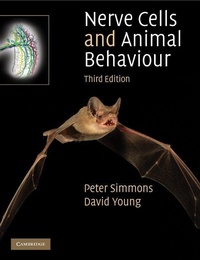
Nerve Cells and Animal Behaviour
3rd Edition
Published on 27. May 2010
Book
Paperback/Softback
294 pages
978-0-521-72848-5 (ISBN)
Description
An extensively revised third edition of this introduction to neuroethology - the neuronal basis of animal behaviour - for zoology, biology and psychology undergraduate students. The book focuses on the roles of individual nerve cells in behaviour, from simple startle responses to complex behaviours such as route learning by rats and singing by crickets and birds. It begins by examining the relationship between brains and behaviour, and showing how study of specialised behaviours reveals neuronal mechanisms that control behaviour. Information processing by nerve cells is introduced using specific examples, and the establishing roles of neurons in behaviour is described for a predator-prey interaction, toads versus cockroaches. New material includes: vision by insects, which describes sensory filtering; hunting by owls and bats, which describes sensory maps; and rhythmical movements including swimming and flying, which describes how sequences of movements are generated. Includes stunning photographs which capture the detail of the behaviour.
Reviews / Votes
"This introduction is easy to read and makes the book accessible to anyone with at least a basic understanding of biology who wants to be introduced to neuroethology. Nerve Cells and Animal Behaviour is a great introduction to behavioral science."Nicolas Dray, Yale Journal of Biology and Medicine "Throughout, the prose is lively and the discussions of even complex phenomena are lucid. The figures are carefully crafted to be clear and uncluttered, and there are just enough of them to keep the explanations moving along. Nerve Cells and Animal Behaviour is an interesting and pleasant read that conveys the thrill of studying the neural basis of animal behavior; it would be ideal for triggering interesting discussions in a relatively small biology or psychology course.
William B. Kristan, Jr., The Quarterly Review of Biology
More details
Edition
3rd Revised edition
Language
English
Place of publication
Cambridge
United Kingdom
Target group
College/higher education
Professional and scholarly
Edition type
Revised edition
Product notice
Paperback (trade)
Illustrations
20 Halftones, black and white; 117 Line drawings, black and white
Dimensions
Height: 246 mm
Width: 189 mm
Thickness: 16 mm
Weight
573 gr
ISBN-13
978-0-521-72848-5 (9780521728485)
Copyright in bibliographic data and cover images is held by Nielsen Book Services Limited or by the publishers or by their respective licensors: all rights reserved.
Schweitzer Classification
Other editions
Additional editions
Peter Simmons | David Young
Nerve Cells and Animal Behaviour
E-Book
10/2012
3rd Edition
Cambridge University Press
€44.49
Available for download
Previous edition
Peter J. Simmons | David Young
Nerve Cells and Animal Behaviour
Book
09/1999
2nd Edition
Cambridge University Press
€27.27
Article exhausted; check for reprint
Persons
Peter Simmons regularly publishes research on insect neurobiology, especially on the ocellar and compound eye visual systems and their role in controlling flight, and on the physiology of synaptic transmission. He is currently Director of the Zoology Degree at Newcastle. David Young has undertaken research and teaching on the link between neurobiology and behaviour in insects, looking at both sensory and motor systems. A special interest has been the mechanisms of sound production in crickets and cicadas. He is also the author of The Discovery of Evolution (2007).
Content
1. Organisation of animal behaviour and of brains - feeding in star-nose moles and courtship in fruit flies; 2. Signals in nerve cells - reflexes in mammals and insects; 3. Neuronal mechanisms for releasing behaviour - predator and prey: toad and cockroach; 4. Neuronal pathways for behaviour - startle behaviours and giant neurons in crayfish and fish; 5. Eyes and vision - sensory filtering and course control in insects; 6. Sensory maps - hunting by owls and bats; 7. Programmes for movement - how nervous systems generate and control rhythmic movements; 8. Changes in nerve cells and behaviour - learning in bees and rats; swarming in locusts; 9. Nerve cells and animal signalling - songs of crickets, electric fish and birds.