

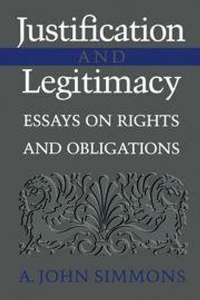
Justification and Legitimacy
Essays on Rights and Obligations
Published on 30. October 2000
Book
Hardback
292 pages
978-0-521-79016-1 (ISBN)
Description
A. John Simmons is widely regarded as one of the most innovative and creative of today's political philosophers. His work on political obligation is regarded as definitive and he is also internationally respected as an interpreter of John Locke. The characteristic features of clear argumentation and careful scholarship that have been hallmarks of his philosophy are everywhere evident in this collection. The essays focus on the problems of political obligation and state legitimacy as well as on historical theories of property and justice. Cumulatively the collection presents a distinctive social and political philosophy, exploring the nature of our most fundamental rights and obligations, and displaying the power and plausibility of Lockean ideal theory.
Reviews / Votes
"...there is no question that this is an extraordinarily fine collection of essays. Whatever one thinks of the Lockean approach, every political theorist should read this book; it is clearly written, tightly argued, and concerns core issues in political philosophy. In short, it is a model of how political philosophy should be done." EthicsMore details
Language
English
Place of publication
Cambridge
United Kingdom
Target group
College/higher education
Professional and scholarly
Dimensions
Height: 235 mm
Width: 157 mm
Thickness: 22 mm
Weight
628 gr
ISBN-13
978-0-521-79016-1 (9780521790161)
Copyright in bibliographic data and cover images is held by Nielsen Book Services Limited or by the publishers or by their respective licensors: all rights reserved.
Schweitzer Classification
Other editions
Additional editions
E-Book
10/2000
Cambridge University Press
€38.49
Available for download
Person
Content
Introduction; 1. The principle of fair play; 2. Fair play and political obligation: twenty years later; 3. The obligations of citizens and the justification of conscription; 4. Associative political obligations; 5. External justifications and institutional roles; 6. Philosophical anarchism; 7. Justification and legitimacy; 8. 'Denisons' and 'Aliens': Locke's problem of political consent; 9. Human rights and world citizenship: the universality of Human Rights in Kant and Locke; 10. Original-acquisition justifications of private property; 11. Historical rights and fair shares; 12. Makers' rights.