

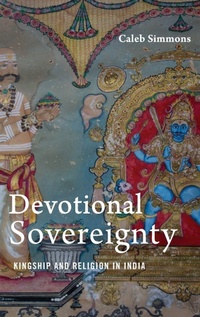
Devotional Sovereignty
Kingship and Religion in India
Published on 24. January 2020
Book
Hardback
296 pages
978-0-19-008889-7 (ISBN)
Description
Devotional Sovereignty: Kingship and Religion in India investigates the shifting conceptualization of sovereignty in the South Indian kingdom of Mysore during the reigns of Tipu Sultan (r. 1782-1799) and Krishnaraja Wodeyar III (r. 1799-1868). Tipu Sultan was a Muslim king famous for resisting British dominance until his death; Krishnaraja III was a Hindu king who succumbed to British political and administrative control. Despite their differences, the courts of both kings dealt with the changing political landscape by turning to the religious and mythical past to construct a royal identity for their kings. Caleb Simmons explores the ways in which these two kings and their courts modified and adapted pre-modern Indian notions of sovereignty and kingship in reaction to British intervention.
The religious past provided an idiom through which the Mysore courts could articulate their rulers' claims to kingship in the region, attributing their rule to divine election and employing religious vocabulary in a variety of courtly genres and media. Through critical inquiry into the transitional early colonial period, this study sheds new light on pre-modern and modern India, with implications for our understanding of contemporary politics. It offers a revisionist history of the accepted narrative in which Tipu Sultan is viewed as a radical Muslim reformer and Krishnaraja III as a powerless British puppet. Simmons paints a picture of both rulers in which they work within and from the same understanding of kingship, utilizing devotion to Hindu gods, goddesses, and gurus to perform the duties of the king.
The religious past provided an idiom through which the Mysore courts could articulate their rulers' claims to kingship in the region, attributing their rule to divine election and employing religious vocabulary in a variety of courtly genres and media. Through critical inquiry into the transitional early colonial period, this study sheds new light on pre-modern and modern India, with implications for our understanding of contemporary politics. It offers a revisionist history of the accepted narrative in which Tipu Sultan is viewed as a radical Muslim reformer and Krishnaraja III as a powerless British puppet. Simmons paints a picture of both rulers in which they work within and from the same understanding of kingship, utilizing devotion to Hindu gods, goddesses, and gurus to perform the duties of the king.
Reviews / Votes
In his brilliant and evocative boook, Devotional Sovereignty: Kingship and Religion in India, Caleb Simmons...importantly centers questions of theology in relation to sovereignty, making Devotional Sovereignty essential reading... * Rajbir Singh Judge, CSU, Long Beach, Religion * Drawing upon a rich range of sources * royal histories, genealogical inscriptions, portraiture and visual narrativesSimmons eloquently argues for the centrality of devotion to the construction and sustenance of sovereignty in Mysore when British colonial authority was established, extended, and consolidated. A compelling and original contribution to studies of Hinduism, kingship, visual and literary culture at a time of political change.Crispin Branfoot, Reader in the History of South Asian Art & Archaeology, SOAS University of London * By mining literary and visual sources respecting two South Indian kings * Mysore's Tipu Sultan and Krishnaraja Wodeyar IIICaleb Simmons shows how the idea of sovereignty was transformed during the dawn and high noon of British colonial rule. Challenging essentialized notions of Hindu or Muslim kingship, the book will prove indispensable for both historians of early modern India and students of religious studies.Richard M. Eaton, author of India in the Persianate Age, 1000-1765 * Devotional Sovereignty bridges several gaps in the scholarship on sacred kingship and religion in eighteenth- and nineteenth-century South India. It is especially commendable that Simmons combines an analysis of narrative sources across a wide range of archives and languages with a close reading of artistic productions and performances in royal and temple spaces. Scholars within and outside the field of South Asian studies will benefit from this erudite work. * A. Azfar Moin, Associate Professor, The University of Texas at Austin * This is a wellcrafted, richly detailed analysis of two kings that should be of great value to anyone with an interest in the idioms of sovereignty in early modern, colonial, and contemporary India. * Robin Rinehart, International Journal of Hindu Studies *More details
Series
Language
English
Place of publication
New York
United States
Target group
Professional and scholarly
Dimensions
Height: 240 mm
Width: 161 mm
Thickness: 22 mm
Weight
655 gr
ISBN-13
978-0-19-008889-7 (9780190088897)
Copyright in bibliographic data and cover images is held by Nielsen Book Services Limited or by the publishers or by their respective licensors: all rights reserved.
Schweitzer Classification
Other editions
Additional editions
E-Book
12/2019
OUP eBook
€48.99
Available for download
E-Book
12/2019
OUP eBook
€62.99
Available for download
Person
Dr. Caleb Simmons (Ph.D. in Religion, University of Florida) specializes in religion in South Asia, especially Hinduism. His research specialties span religion and state-formation in medieval and colonial India to contemporary transnational aspects of Hinduism. He has publications and continuing research interests related to a broad range of contemporary topics, including ecological issues and sacred geography in India; South Asian diaspora communities; and material and popular cultures that arise as a result of globalization-especially South Asian religions as portrayed in comic books and graphic novels. He teaches courses on Hinduism, Indian religions, and method and theory of Religious Studies.
Content
Introduction: Kingship and Sovereignty in Mysore
Section ONE: Tipu Sultan
Chapter 1: The King of Seringapatam
Chapter 2: The Sultan, the Sufi, and the Guru
Chapter 3: Divine Warfare and Diplomacy
Section Two: Krishnaraja Wodeyar III
Chapter 4: Restoring An "Ancient Hindu" Family
Chapter 5: Portraying Devotion
Chapter 6: Displaying Power
Chapter 7: Mapping New Sovereignty
Epilogue
Section ONE: Tipu Sultan
Chapter 1: The King of Seringapatam
Chapter 2: The Sultan, the Sufi, and the Guru
Chapter 3: Divine Warfare and Diplomacy
Section Two: Krishnaraja Wodeyar III
Chapter 4: Restoring An "Ancient Hindu" Family
Chapter 5: Portraying Devotion
Chapter 6: Displaying Power
Chapter 7: Mapping New Sovereignty
Epilogue