

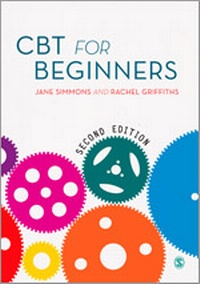
CBT for Beginners
2nd Edition
Published on 16. December 2013
Book
Hardback
272 pages
978-1-4462-5890-3 (ISBN)
Description
CBT for Beginners, Second Edition is designed to help your students make the best start in their careers as confident CBT therapists. Comprising all the main theory and competencies covered in training, this book takes your students right back to basics, equipping them with the essential nuts and bolts to practice CBT effectively.
Key features include:
- Written in a language familiar to first year trainees, offering your students an accessible route in to the subject.
- Exercises and case dialogue to invite critical reflection and enhance learning.
- Summary boxes to check your students' understanding of key content along the way.
- Further reading lists to allow students to take what they have learnt to the next step.
Focusing on case formulation, the authors show how to build a 'picture' of each individual client, using their case history to inform interventions. What results is a practical guide to the fundamentals of practicing CBT, making this the ideal starter text for CBT modules on any of your counselling, psychotherapy or wider health care courses.
Key features include:
- Written in a language familiar to first year trainees, offering your students an accessible route in to the subject.
- Exercises and case dialogue to invite critical reflection and enhance learning.
- Summary boxes to check your students' understanding of key content along the way.
- Further reading lists to allow students to take what they have learnt to the next step.
Focusing on case formulation, the authors show how to build a 'picture' of each individual client, using their case history to inform interventions. What results is a practical guide to the fundamentals of practicing CBT, making this the ideal starter text for CBT modules on any of your counselling, psychotherapy or wider health care courses.
Reviews / Votes
A succinct, clear guide to the basics of CBT. -- Dr Ann Hackmann I use this book in my teaching of Masters of Clinical Psychology students and they love it. It's easy to read and follow, providing a great starting point for trainee psychologists to learn the basics of CBT. Students really grasp the concepts well and it increases their confidence in delivering therapy. -- Dr Vivienne Lewis CBT for beginners initially appears to be a rather daunting concept when the text is rather large. However, the format of this text book provides a no nonsense and completely user-friendly directory for both student, academic and practitioner use.I enjoyed the way in which each chapter is broken down, each section, concept and idea separated and highlighted and how each one has some key points at the end by way of an aid memoir. I will certainly be using this with counselling and communication students as it presents a series of case studies and scenarios which are relevant and accessible.
CBT for beginners is written in a way which does not compromise on academic and theoretical content but that breaks down important issues, challenges and practices so that the reader not only has an opportunity to reflect on what they have learnt but also ways in which practical skills might be applied. -- Tracie Trimmer-Platman
More details
Edition
2nd Revised edition
Language
English
Place of publication
London
United Kingdom
Target group
College/higher education
Edition type
Revised edition
Dimensions
Height: 242 mm
Width: 170 mm
Weight
621 gr
ISBN-13
978-1-4462-5890-3 (9781446258903)
Copyright in bibliographic data and cover images is held by Nielsen Book Services Limited or by the publishers or by their respective licensors: all rights reserved.
Schweitzer Classification
Other editions
New editions
Jane Simmons | Rachel Griffiths
CBT for Beginners
Book
11/2017
3rd Edition
SAGE Publications Ltd
€158.10
Shipment within 15-20 days
Previous edition
Jane Simmons | Rachel Griffiths
CBT for Beginners
Book
12/2008
1st Edition
SAGE Publications Inc
€112.85
Article exhausted; check for reprint
Persons
Jane Simmons works as a Clinical Psychologist in adult mental health services in South Wales. She has previously worked as a project manager setting up an IAPT service in England. She has worked in the NHS since gaining her doctorate in Clinical Psychology in 2000 from the Oxford doctoral course of Clinical Psychology and also works in Independent Practice in Bristol. Rachel Griffiths is a Consultant Clinical Psychologist working in South Wales. She has worked in the NHS since gaining her doctorate in clinical Psychology in 2003 . Rachel has worked with adults with mental health problems in inpatient and community settings and currently works in a service for people with chronic pain.
Content
PART ONE: CBT - WHAT IS IT?
What is CBT?
CBT: Historical and Theoretical Background
Who Benefits from CBT?
The CBT Model
Levels of Cognitions (Thoughts, Beliefs and Assumptions)
Structure of therapy and sessions
The therapeutic relationship
PART TWO: CBT - HOW DO YOU DO IT?
CBT Assessment
CBT formulation
Setting Therapy Goals
Coping Strategies
Behavioural interventions
Cognitive interventions: Psycho-education about thoughts and beliefs
Cognitive interventions: Identifying negative automatic thoughts
Cognitive Interventions: Evaluation of Negative Automatic Thoughts or 'Thought Challenging'
Cognitive Interventions: Working with assumptions and core beliefs
Working with emotions
PART THREE: AND THE REST...
Mindfulness
Problem Solving
Motivation for Change
Therapeutic Endings
Supervision
What is CBT?
CBT: Historical and Theoretical Background
Who Benefits from CBT?
The CBT Model
Levels of Cognitions (Thoughts, Beliefs and Assumptions)
Structure of therapy and sessions
The therapeutic relationship
PART TWO: CBT - HOW DO YOU DO IT?
CBT Assessment
CBT formulation
Setting Therapy Goals
Coping Strategies
Behavioural interventions
Cognitive interventions: Psycho-education about thoughts and beliefs
Cognitive interventions: Identifying negative automatic thoughts
Cognitive Interventions: Evaluation of Negative Automatic Thoughts or 'Thought Challenging'
Cognitive Interventions: Working with assumptions and core beliefs
Working with emotions
PART THREE: AND THE REST...
Mindfulness
Problem Solving
Motivation for Change
Therapeutic Endings
Supervision