

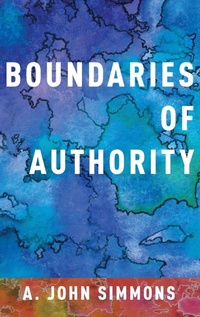
Boundaries of Authority
Published on 5. July 2016
Book
Hardback
272 pages
978-0-19-060348-9 (ISBN)
Description
Modern states claim rights of jurisdiction and control over particular geographical areas and their associated natural resources. Boundaries of Authority explores the possible moral bases for such territorial claims by states, in the process arguing that many of these territorial claims in fact lack any moral justification. The book maintains throughout that the requirement of states' justified authority over persons has normative priority over,
and as a result severely restricts, the kinds of territorial rights that states can justifiably claim, and it argues that the mere effective administration of justice within a geographical area is insufficient to ground moral authority over residents of that area. The book argues that only a theory of territorial
rights that takes seriously the morality of the actual history of states' acquisitions of power over land and the land's residents can adequately explain the nature and extent of states' moral rights over particular territories. Part I of the book examines the interconnections between states' claimed rights of authority over particular sets of subject persons and states' claimed authority to control particular territories. It contains an extended critique of the dominant "Kantian
functionalist " approach to such issues. Part II organizes, explains, and criticizes the full range of extant theories of states' territorial rights, arguing that a little-appreciated Lockean approach to territorial rights is in fact far better able to meet the principal desiderata for such theories. Where
the first two parts of the book concern primarily states' claims to jurisdiction over territories, Part III of the book looks closely at the more property-like territorial rights that states claim - in particular, their claimed rights to control over the natural resources on and beneath their territories and their claimed rights to control and restrict movement across (including immigration over) their territorial borders.
and as a result severely restricts, the kinds of territorial rights that states can justifiably claim, and it argues that the mere effective administration of justice within a geographical area is insufficient to ground moral authority over residents of that area. The book argues that only a theory of territorial
rights that takes seriously the morality of the actual history of states' acquisitions of power over land and the land's residents can adequately explain the nature and extent of states' moral rights over particular territories. Part I of the book examines the interconnections between states' claimed rights of authority over particular sets of subject persons and states' claimed authority to control particular territories. It contains an extended critique of the dominant "Kantian
functionalist " approach to such issues. Part II organizes, explains, and criticizes the full range of extant theories of states' territorial rights, arguing that a little-appreciated Lockean approach to territorial rights is in fact far better able to meet the principal desiderata for such theories. Where
the first two parts of the book concern primarily states' claims to jurisdiction over territories, Part III of the book looks closely at the more property-like territorial rights that states claim - in particular, their claimed rights to control over the natural resources on and beneath their territories and their claimed rights to control and restrict movement across (including immigration over) their territorial borders.
Reviews / Votes
Summing Up: Recommended. * J.C. Hickman, CHOICE * Simmons's important book diagnoses a fundamental "boundary" problem for contemporary political theory, and there is much to learn about territorial questions from its pages. As the best developed Lockean account of boundaries, it is essential reading for anyone interested in these matters. * Anna Stilz, Notre Dame Philosophical Reviews *More details
Other editions
Additional editions
A. John Simmons
Boundaries of Authority
E-Book
07/2016
1st Edition
OUP eBook
€63.49
Available for download
A. John Simmons
Boundaries of Authority
E-Book
06/2016
1st Edition
OUP eBook
€63.49
Available for download
Person
A. JOHN SIMMONS is Commonwealth Professor of Philosophy and Professor of Law at the University of Virginia. He has been an editor of the journal Philosophy & Public Affairs since 1982. He is the author of Moral Principles and Political Obligations (1979), The Lockean Theory of Rights (1992), On the Edge of Anarchy: Locke, Consent, and the Limits of Society (1993), Justification and Legitimacy: Essays on
Rights and Obligations (2000), Is There a Duty to Obey the Law? For and Against (with C.H. Wellman) (2005), Political Philosophy (OUP, 2008), and many other publications on topics in moral, political, and legal philosophy. He has edited the books International Ethics (1985) and Punishment (1995) and has chaired the University of Virginia's Philosophy
Department and its Program on Political and Social Thought.
Rights and Obligations (2000), Is There a Duty to Obey the Law? For and Against (with C.H. Wellman) (2005), Political Philosophy (OUP, 2008), and many other publications on topics in moral, political, and legal philosophy. He has edited the books International Ethics (1985) and Punishment (1995) and has chaired the University of Virginia's Philosophy
Department and its Program on Political and Social Thought.