

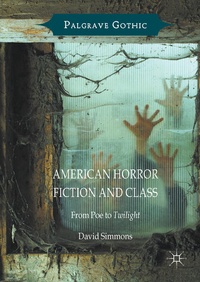
American Horror Fiction and Class
From Poe to Twilight
Published on 2. October 2017
Book
Hardback
IX, 201 pages
978-1-137-53279-4 (ISBN)
Description
In this book, Simmons argues that class, as much as race and gender, played a significant role in the development of Gothic and Horror fiction in a national context. From the classic texts of Edgar Allen Poe and Nathaniel Hawthorne right through to contemporary examples, such as the novels of Stephen King and Stephenie Meyer's
Twilight
Series, class remains an ever present though understudied element. This study will appeal to scholars of American Studies, English literature, Media and Cultural Studies interested in class representations in the horror genre from the nineteenth century to the present day.
More details
Series
Edition
2017 ed.
Language
English
Place of publication
London
United Kingdom
Target group
Professional and scholarly
Illustrations
IX, 201 p.
Dimensions
Height: 216 mm
Width: 153 mm
Thickness: 15 mm
Weight
393 gr
ISBN-13
978-1-137-53279-4 (9781137532794)
DOI
10.1057/978-1-137-53280-0
Schweitzer Classification
Other editions
Additional editions
E-Book
09/2017
1st Edition
Palgrave Macmillan
€32.09
Available for download
Person
David Simmons is Senior Lecturer in English and Screen Studies at The University of Northampton, UK. He has published extensively in the field of American literature and culture, including books on the representation of the Anti-Hero during the 1960s, H.P. Lovecraft, and Twentieth Century Canonical fiction.
Content
1. Introduction: Establishing the Place of Class in US Gothic and Horror Fiction.- 2. Class and Horror Fiction during the Early Twentieth Century.- 3. Class and Horror Fiction at Mid-Century.- 4. Representing Class during the Horror Boom of the 1970s and 1980s.- 5. Horror Fiction and Class in the Contemporary1. Introduction: Establishing the Place of Class in US Gothic and Horror Fiction.- 2. Class and Horror Fiction during the Early Twentieth Century.- 3. Class and Horror Fiction at Mid-Century.- 4. Representing Class during the Horror Boom of the 1970s and 1980s.- 5. Horror Fiction and Class in the Contemporary Period. Period.