

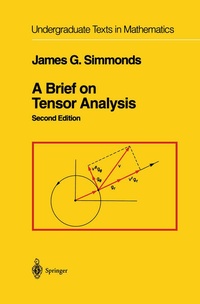
A Brief on Tensor Analysis
2nd Edition
Published on 19. November 1993
Book
Hardback
XIV, 114 pages
978-0-387-94088-5 (ISBN)
Description
There are three changes in the second edition. First, with the help of readers and colleagues-thanks to all-I have corrected typographical errors and made minor changes in substance and style. Second, I have added a fewmore Exercises,especially at the end ofChapter4.Third, I have appended a section on Differential Geometry, the essential mathematical tool in the study of two-dimensional structural shells and four-dimensional general relativity. JAMES G. SIMMONDS vii Preface to the First Edition When I was an undergraduate, working as a co-op student at North Ameri can Aviation, I tried to learn something about tensors. In the Aeronautical Engineering Department at MIT, I had just finished an introductory course in classical mechanics that so impressed me that to this day I cannot watch a plane in flight-especially in a turn-without imaging it bristling with vec tors. Near the end of the course the professor showed that, if an airplane is treated as a rigid body, there arises a mysterious collection of rather simple looking integrals called the components of the moment of inertia tensor.
More details
Series
Edition
Second Edition 1994
Language
English
Place of publication
New York
United States
Target group
Lower undergraduate
Edition type
Revised edition
Illustrations
XIV, 114 p.
Dimensions
Height: 241 mm
Width: 160 mm
Thickness: 13 mm
Weight
371 gr
ISBN-13
978-0-387-94088-5 (9780387940885)
DOI
10.1007/978-1-4419-8522-4
Schweitzer Classification
Other editions
Additional editions
James G. Simmonds
A Brief on Tensor Analysis
E-Book
10/2012
2nd Edition
Springer
€42.99
Available for download
James G. Simmonds
A Brief on Tensor Analysis
Book
10/2012
2nd Edition
Springer
€43.82
Shipment within 15-20 days
Previous edition
James G. Simmonds
A Brief on Tensor Analysis
Book
01/1982
Springer
€30.36
Article exhausted; check for reprint
Content
I Introduction: Vectors and Tensors.- Three-Dimensional Euclidean Space.- Directed Line Segments.- Addition of Two Vectors.- Multiplication of a Vector v by a Scalar ?.- Things That Vectors May Represent.- Cartesian Coordinates.- The Dot Product.- Cartesian Base Vectors.- The Interpretation of Vector Addition.- The Cross Product.- Alternative Interpretation of the Dot and Cross Product. Tensors.- Definitions.- The Cartesian Components of a Second Order Tensor.- The Cartesian Basis for Second Order Tensors.- Exercises.- II General Bases and Tensor Notation.- General Bases.- The Jacobian of a Basis Is Nonzero.- The Summation Convention.- Computing the Dot Product in a General Basis.- Reciprocal Base Vectors.- The Roof (Contravariant) and Cellar (Covariant) Components of a Vector.- Simplification of the Component Form of the Dot Product in a General Basis.- Computing the Cross Product in a General Basis.- A Second Order Tensor Has Four Sets of Components in General.- Change of Basis.- Exercises.- III Newton's Law and Tensor Calculus.- Rigid Bodies.- New Conservation Laws.- Nomenclature.- Newton's Law in Cartesian Components.- Newton's Law in Plane Polar Coordinates.- The Physical Components of a Vector.- The Christoffel Symbols.- General Three-Dimensional Coordinates.- Newton's Law in General Coordinates.- Computation of the Christoffel Symbols.- An Alternative Formula for Computing the Christoffel Symbols.- A Change of Coordinates.- Transformation of the Christoffel Symbols.- Exercises.- IV The Gradient, the Del Operator, Covariant Differentiation, and the Divergence Theorem.- The Gradient.- Linear and Nonlinear Eigenvalue Problems.- The Del Operator.- The Divergence, Curl, and Gradient of a Vector Field.- The Invariance of ? · v, ? × v, and ?v.- The Covariant Derivative.- The Component Forms of ? · v, ? × v, and ?v.- The Kinematics of Continuum Mechanics.- The Divergence Theorem.- Differential Geometry.- Exercises.