

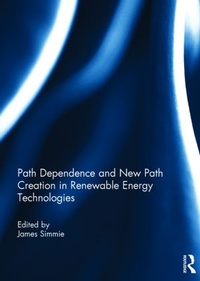
Path Dependence and New Path Creation in Renewable Energy Technologies
1st Edition
Published on 26. June 2014
Book
Hardback
178 pages
978-1-138-02417-5 (ISBN)
Description
Why are old technologies persisted with after better alternatives have been invented? This book examines this question, a central concern of evolutionary economics, specifically focusing on renewable energy technologies. The concept of path dependence is used to analyse why and how technological development can become locked-in to inefficient ways of doing things. This book shows how lock-in can be avoided by the creation of new technological pathways.
The chapters focus on the comparatively recent introduction of new wind turbine technologies for the generation of carbon free electricity. This case study provides valuable lessons in understanding the issues confronting inventors attempting to commercialise their new ideas in the form of innovations in the face of historically established conventional technologies. It is also set within the critical debate on climate change and the need to de-carbonise energy supplies in order to stop further man-made deterioration in the global environment.
This book was originally published as a special issue of European Planning Studies.
The chapters focus on the comparatively recent introduction of new wind turbine technologies for the generation of carbon free electricity. This case study provides valuable lessons in understanding the issues confronting inventors attempting to commercialise their new ideas in the form of innovations in the face of historically established conventional technologies. It is also set within the critical debate on climate change and the need to de-carbonise energy supplies in order to stop further man-made deterioration in the global environment.
This book was originally published as a special issue of European Planning Studies.
More details
Language
English
Place of publication
London
United Kingdom
Publishing group
Taylor & Francis Ltd
Target group
College/higher education
Professional and scholarly
Academic and Postgraduate
Dimensions
Height: 246 mm
Width: 174 mm
Weight
490 gr
ISBN-13
978-1-138-02417-5 (9781138024175)
Copyright in bibliographic data and cover images is held by Nielsen Book Services Limited or by the publishers or by their respective licensors: all rights reserved.
Schweitzer Classification
Other editions
Additional editions
Book
10/2024
1st Edition
Routledge
€71.98
Shipment within 10-20 days
E-Book
01/2016
1st Edition
Routledge
€55.49
Available for download
E-Book
01/2016
1st Edition
Routledge
€55.49
Available for download
Person
James Simmie is professor of Innovation Studies at Oxford Brookes University, UK. His work is focused on the relationships between innovation, productivity and the competitiveness of urban regions. It is developed within the theoretical framework of evolutionary economics and geography. Over the years he has published widely on these themes. Some of his more recent publications are available to download from http://planning.brookes.ac.uk/staff/jamessimmie.html
Content
1. Introduction: Path Dependence and New Path Creation in Renewable Energy Technologies James Simmie Part I: Theories 2. Path Creation: Co-creation of Heterogeneous Resources in the Emergence of the Danish Wind Turbine Cluster Peter Karnoe and Raghu Garud 3. Path Dependence and New Technological Path Creation in the Danish Wind Power Industry James Simmie 4. Comparing Alternative Path Creation Frameworks in the Context of Emerging Biofuel Fields in the Netherlands, Sweden and Finland Raimo Lovio and Paula Kivimaa Part II: Geographies 5. Renewable Energy Technology and Path Creation: A Multi-scalar Approach to Energy Transition in the UK Juergen Essletzbichler 6. Transversality and Transition: Green Innovation and New Regional Path Creation Philip Cooke 7. From the Old Path of Shipbuilding onto the New Path of Offshore Wind Energy? The Case of Northern Germany Dirk Fornahl, Robert Hassink, Claudia Klaerding, Ivo Mossig and Heike Schroeder 8. Spatial Processes of Industry Emergence: US Wind Turbine Manufacturing Industry Gregory Theyel Part III: Policy 9. Clean Energy Technology and the Role of Non-Carbon Price-Based Policy: An Evolutionary Economics Perspective Nicholas Howarth