

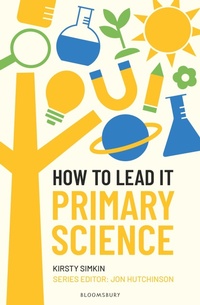
How to Lead it: Primary Science
Published on 14. August 2025
Book
Paperback/Softback
192 pages
978-1-80199-626-6 (ISBN)
Description
Finding it hard to know what to prioritise as subject lead or how to work out which research is relevant and how it applies to your subject? The How to Lead It series are the go-to guides for primary subject leads in schools and trusts. In them you will find:
- clear summaries of relevant research and thinking around best practice
- age-specific and inclusive classroom examples
- case studies
- reflective questions
- suggestions for short PD sessions with colleagues
Everything in the book is applied thoughtfully to the specific subject area of science. These books enable busy subject leaders to confidently make good decisions for effective teaching and impactful curricula.
All the key elements of the primary science curriculum are explored including curriculum planning, assessment, modelling, engagement, practical science and dialogue as well as support on how to approach research and a step-by-step guide to implementing changes in realistic and inclusive ways.
- clear summaries of relevant research and thinking around best practice
- age-specific and inclusive classroom examples
- case studies
- reflective questions
- suggestions for short PD sessions with colleagues
Everything in the book is applied thoughtfully to the specific subject area of science. These books enable busy subject leaders to confidently make good decisions for effective teaching and impactful curricula.
All the key elements of the primary science curriculum are explored including curriculum planning, assessment, modelling, engagement, practical science and dialogue as well as support on how to approach research and a step-by-step guide to implementing changes in realistic and inclusive ways.
Reviews / Votes
It's no secret that primary science has suffered in recent years, and is often seen as secondary to English and maths. Whilst the reasons for this decline might be varied and complex, there's no doubt that Kirsty Simkin's work should be seen as part of the solution. Kirsty has produced an accessible yet scholarly review of the major issues facing primary science, and by covering a vast range of concepts has given current and aspiring primary leaders plentiful tools to deploy in their schools. We know that primary children love science and studying the world around them, and there is no doubt that Kirsty's book will help primary teachers across the country grow that love and enthusiasm, and harness it to guide students to greater knowledge and understanding. -- Adam Boxer * achemicalorthodoxy.wordpress.com, @adamboxer1 * Steeped in evidence and delightfully clear-every science lead should read this 3 times. -- Peps McCrea * Teacher educator and author * The perennial challenge for primary leaders is supporting colleagues to teach everything well-often without specialist training or time. This series meets that challenge head on. It's full of evidence-based strategies that will help leaders to build powerful, knowledge-rich curriculums and teaching practices in a range of subjects. -- Daisy Christodoulou * Director of Education, No More Marking *More details
Series
Language
English
Place of publication
United Kingdom
Publishing group
Bloomsbury Publishing PLC
Target group
Professional and scholarly
Primary & secondary/elementary & high school
Dimensions
Height: 233 mm
Width: 154 mm
Thickness: 14 mm
Weight
292 gr
ISBN-13
978-1-80199-626-6 (9781801996266)
Copyright in bibliographic data and cover images is held by Nielsen Book Services Limited or by the publishers or by their respective licensors: all rights reserved.
Schweitzer Classification
Persons
Kirsty Simkin is a primary teacher, science lead, governor and senior leader. She began her career through Teach First teaching at an all-through academy in London. She has worked with multiple organisations and schools, including Oak National Academy and Ambition Institute, consulting and speaking on curriculum design and as a science subject expert.
Series editor Jon Hutchinson is Director of Curriculum and Teacher Development at the Reach Foundation. Prior to this, Jon was a primary school teacher, A level religious studies teacher, and assistant headteacher at Reach Academy Feltham. Jon was also a Visiting Fellow with Ambition Institute, tutoring on a Master's in Expert Teaching programme. During the Covid-19 pandemic, Jon was a founding member of Oak National Academy, leading the primary humanities curriculum. He has acted as an expert adviser to the DfE on various groups, including as a member of the core group which developed the Early Career Framework. Jon has written several chapters in educational books, is regularly published by the TES, Schools Week and Teach Primary, and is currently writing two books on education. Follow Jon @jon_hutchinson_ on X and Bluesky.
Series editor Jon Hutchinson is Director of Curriculum and Teacher Development at the Reach Foundation. Prior to this, Jon was a primary school teacher, A level religious studies teacher, and assistant headteacher at Reach Academy Feltham. Jon was also a Visiting Fellow with Ambition Institute, tutoring on a Master's in Expert Teaching programme. During the Covid-19 pandemic, Jon was a founding member of Oak National Academy, leading the primary humanities curriculum. He has acted as an expert adviser to the DfE on various groups, including as a member of the core group which developed the Early Career Framework. Jon has written several chapters in educational books, is regularly published by the TES, Schools Week and Teach Primary, and is currently writing two books on education. Follow Jon @jon_hutchinson_ on X and Bluesky.
Content
1. Leading science
2. Getting the best from research evidence
3. Big ideas in science
4. Curriculum design principles
5. How to plan a curriculum
6. Assessment: what do my pupils know?
7. Explanations and modelling
8. Vocabulary
9. Practical science
10. Dialogue
11. Disciplinary literacy
12. Engagement in science
13. Implementing change
2. Getting the best from research evidence
3. Big ideas in science
4. Curriculum design principles
5. How to plan a curriculum
6. Assessment: what do my pupils know?
7. Explanations and modelling
8. Vocabulary
9. Practical science
10. Dialogue
11. Disciplinary literacy
12. Engagement in science
13. Implementing change