

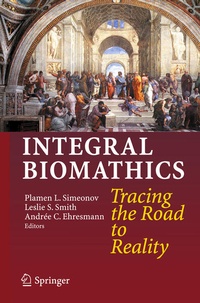
Integral Biomathics
Tracing the Road to Reality
Published on 9. August 2014
Book
Paperback/Softback
XXIV, 432 pages
978-3-642-42960-6 (ISBN)
Description
Perhaps the most distinct question in science throughout the ages has been the one of perceivable reality, treated both in physics and philosophy. Reality is acting upon us, and we, and life in general, are acting upon reality. Potentiality, found both in quantum reality and in the activity of life, plays a key role. In quantum reality observation turns potentiality into reality. Again, life computes possibilities in various ways based on past actions, and acts on the basis of these computations. This book is about a new approach to biology (and physics, of course!). Its subtitle suggests a perpetual movement and interplay between two elusive aspects of modern science - reality/matter and potentiality/mind, between physics and biology - both captured and triggered by mathematics - to understand and explain emergence, development and life all the way up to consciousness. But what is the real/potential difference between living and non-living matter? How does time in potentiality differ from time in reality? What we need to understand these differences is an integrative approach. This book contemplates how to encircle life to obtain a formal system, equivalent to the ones in physics. Integral Biomathics attempts to explore the interplay between reality and potentiality.
More details
Edition
2012 ed.
Language
English
Place of publication
Berlin
Germany
Publishing group
Springer Berlin
Target group
Professional and scholarly
Research
Illustrations
XXIV, 432 p.
Dimensions
Height: 235 mm
Width: 155 mm
Thickness: 25 mm
Weight
686 gr
ISBN-13
978-3-642-42960-6 (9783642429606)
DOI
10.1007/978-3-642-28111-2
Schweitzer Classification
Other editions
Additional editions
Plamen L. Simeonov | Leslie S. Smith | Andrée C. Ehresmann
Integral Biomathics
Tracing the Road to Reality
Book
07/2012
Springer
€106.99
Shipment within 7-9 days
Content
PART I: Biology and Neuroscience.- PART II: Mathematics and Computation.- PART III: Models and Applications.- PART IV: Physics and Philosophy.- PART V: INBIOSA White Paper.