

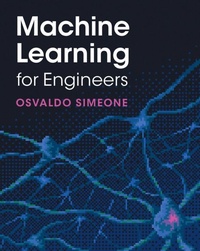
Machine Learning for Engineers
Published on 3. November 2022
Book
Hardback
450 pages
978-1-316-51282-1 (ISBN)
Description
This self-contained introduction to machine learning, designed from the start with engineers in mind, will equip students with everything they need to start applying machine learning principles and algorithms to real-world engineering problems. With a consistent emphasis on the connections between estimation, detection, information theory, and optimization, it includes: an accessible overview of the relationships between machine learning and signal processing, providing a solid foundation for further study; clear explanations of the differences between state-of-the-art techniques and more classical methods, equipping students with all the understanding they need to make informed technique choices; demonstration of the links between information-theoretical concepts and their practical engineering relevance; reproducible examples using Matlab, enabling hands-on student experimentation. Assuming only a basic understanding of probability and linear algebra, and accompanied by lecture slides and solutions for instructors, this is the ideal introduction to machine learning for engineering students of all disciplines.
More details
Language
English
Place of publication
Cambridge
United Kingdom
Illustrations
Worked examples or Exercises
Dimensions
Height: 260 mm
Width: 208 mm
Thickness: 37 mm
Weight
1495 gr
ISBN-13
978-1-316-51282-1 (9781316512821)
Copyright in bibliographic data and cover images is held by Nielsen Book Services Limited or by the publishers or by their respective licensors: all rights reserved.
Schweitzer Classification
Other editions
Additional editions
Osvaldo Simeone
Machine Learning for Engineers
E-Book
01/2023
Cambridge University Press
€72.49
Available for download
Person
Osvaldo Simeone is a Professor of Information Engineering at King's College London, where he directs King's Communications, Learning & Information Processing (KCLIP) lab. He is a Fellow of the IET and IEEE.
Content
Part I. Introduction and Background: 1. When and how to use machine learning; 2. Background. Part II. Fundamental Concepts and Algorithms: 3. Inference, or model-driven prediction; 4. Supervised learning: getting started; 5. Optimization for machine learning; 6. Supervised learning: beyond least squares; 7: Unsupervised learning. Part III. Advanced Tools and Algorithms: 8. Statistical learning theory; 9. Exponential family of distributions; 10. Variational inference and variational expectation maximization; 11. Information-theoretic inference and learning; 12. Bayesian learning. Part IV. Beyond Centralized Single-Task Learning: 13. Transfer learning, multi-task learning, continual learning, and meta-learning; 14. Federated learning. Part V. Epilogue: 15. Beyond this book.