

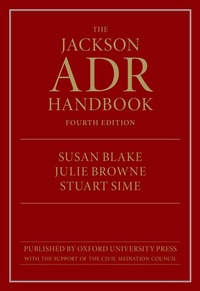
The Jackson ADR Handbook
4th Edition
Published on 27. February 2025
Book
Paperback/Softback
448 pages
978-0-19-893764-7 (ISBN)
Description
The Jackson ADR Handbook^r was written to fulfil a recommendation by Lord Justice Jackson that there should be an authoritative handbook on alternative dispute resolution (ADR). The first edition, published in 2013, laid a strong foundation as an authoritative guide to ADR, receiving judicial endorsement from the Court of Appeal. Subsequent editions built upon that success, becoming a syllabus text prescribed by the Bar Standards Board.
The use of ADR continues to be embedded in dispute resolution in England and Wales, with the Master of the Rolls and the Ministry of Justice implementing reforms that place the use of ADR alongside litigation. This revised fourth edition integrates important new case law, including the landmark case of Churchill v Merthyr Tydfil Borough Council [2023], in which the Court of Appeal decided a court can order parties to engage in a non-court based dispute resolution process, provided the right to a trial remains. Key changes in court rules and pre-action protocols are also covered.
Designed with a concise, user-friendly format, the text provides an in-depth overview of the options and principles for ADR, placing them firmly within the context of litigation, and looking in detail at the relevant court rules and legal principles, such as privacy and legal professional privilege, as well as practical topics such as how to prepare for and what happens during mediation and recording and enforcing settlements.
The use of ADR continues to be embedded in dispute resolution in England and Wales, with the Master of the Rolls and the Ministry of Justice implementing reforms that place the use of ADR alongside litigation. This revised fourth edition integrates important new case law, including the landmark case of Churchill v Merthyr Tydfil Borough Council [2023], in which the Court of Appeal decided a court can order parties to engage in a non-court based dispute resolution process, provided the right to a trial remains. Key changes in court rules and pre-action protocols are also covered.
Designed with a concise, user-friendly format, the text provides an in-depth overview of the options and principles for ADR, placing them firmly within the context of litigation, and looking in detail at the relevant court rules and legal principles, such as privacy and legal professional privilege, as well as practical topics such as how to prepare for and what happens during mediation and recording and enforcing settlements.
More details
Edition
4th Revised edition
Language
English
Place of publication
Oxford
United Kingdom
Target group
Professional and scholarly
Edition type
Revised edition
Product notice
Paperback (trade)
Unsewn / adhesive bound
Dimensions
Height: 213 mm
Width: 147 mm
Thickness: 28 mm
Weight
635 gr
ISBN-13
978-0-19-893764-7 (9780198937647)
Copyright in bibliographic data and cover images is held by Nielsen Book Services Limited or by the publishers or by their respective licensors: all rights reserved.
Schweitzer Classification
Persons
Professor Susan Blake's career, at the Inns of Court School of Law and then at City Law School in London, has focussed on developing legal skills training for barristers and solicitors. This includes a full range of skills from opinion writing to advocacy, and she has focussed in particular on using litigation and other forms of dispute resolution effectively. Most recently, her work has focussed on the impact of technology and generative AI on the work of lawyers, and the ongoing development of the delivery of legal services.
Associate Professor Julie Browne was in practice at the Bar of England and Wales for over 10 years doing a wide range of civil and commercial work. Since joining the Inns of Court School of Law (now City Law School) she has held a variety of roles, including Deputy Course Director (Students) on the Bar Professional Training Course for over 10 years, Director of Student Services and, most recently, Director of Bar Training. As Director of Bar Training, she has responsibility for designing the school's new blended learning programme to meet the needs of the Bar Standard's Board new regulatory changes for future bar training. During her time at City Law School, Julie has also been the subject lead for many modules, including commercial law, company law and drafting and has written and designed many new modules over the years, including alternative dispute resolution and most recently advanced civil advocacy and international arbitration in practice.
Professor Stuart Sime started his academic career at the Inns of Court School of Law primarily teaching civil procedure, but also a range of other subjects, such as evidence, company law and commercial law. He also led at various times skills modules such as civil advocacy and opinion writing. He was the programme director of the largest Bar programme in the country for 15 years. He is currently the Head of Department for the academic programmes at The City Law School, and teaches mediation, international commercial arbitration, and assists with teaching english legal system and ethics.
Associate Professor Julie Browne was in practice at the Bar of England and Wales for over 10 years doing a wide range of civil and commercial work. Since joining the Inns of Court School of Law (now City Law School) she has held a variety of roles, including Deputy Course Director (Students) on the Bar Professional Training Course for over 10 years, Director of Student Services and, most recently, Director of Bar Training. As Director of Bar Training, she has responsibility for designing the school's new blended learning programme to meet the needs of the Bar Standard's Board new regulatory changes for future bar training. During her time at City Law School, Julie has also been the subject lead for many modules, including commercial law, company law and drafting and has written and designed many new modules over the years, including alternative dispute resolution and most recently advanced civil advocacy and international arbitration in practice.
Professor Stuart Sime started his academic career at the Inns of Court School of Law primarily teaching civil procedure, but also a range of other subjects, such as evidence, company law and commercial law. He also led at various times skills modules such as civil advocacy and opinion writing. He was the programme director of the largest Bar programme in the country for 15 years. He is currently the Head of Department for the academic programmes at The City Law School, and teaches mediation, international commercial arbitration, and assists with teaching english legal system and ethics.
Content
1: General Principles of ADR 2: The Range of ADR Options 3: Timing the Use of ADR in Relation to the Progress of a Case 4: Roles and Responsibilities of Lawyers and Parties in ADR 5: Privacy, Privilege, and Confidentiality Clauses 6: Ethics 7: Funding ADR Procedures 8: The Context Where No Proceedings Have Been Issued 9: The Approach of the Courts to ADR 10: Costs and Cost Shifting in ADR 11: Sanctions for Refusing to Engage in ADR Practices 12: Negotiation and Joint Settlement Meetings 13: Mediation: General Principles 14: Preparation for the Mediation 15: The Mediation Process 16: Court Mediation Schemes and Other Schemes 17: EU Directive on Mediation in Civil and Commercial Cases 18: Recording Settlement - Private Agreement 19: Recording Settlement - Court Proceedings 20: Enforcement of Settlements 21: Online ADR and ODR 22: Early Neutral Evaluation 23: Concilation, Complaints, Grievances, and Ombudsmen 24: Expert (or Neutral) Determination 25: Arbitration 26: Construction Industry Adjudication