

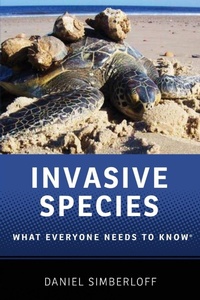
Invasive Species
What Everyone Needs to Know (R)
Published on 31. October 2013
Book
Paperback/Softback
352 pages
978-0-19-992203-1 (ISBN)
Description
Invasive species come in all sizes, from plant pathogens like the chestnut blight in eastern North America, to the red imported fire ant that has spread throughout the South, the predatory Indian mongoose now found in the Caribbean and Hawaii, and the huge Burmese python populating the Florida swamps. And while many invasive species are safe and even beneficial, the more harmful varieties cost the world economy billions of dollars annually, devastate agriculture, spread painful and even lethal diseases, and otherwise diminish our quality of life in myriad surprising ways.
In Invasive Species: What Everyone Needs to Know, award-winning biologist Daniel Simberloff offers a wide-ranging and informative survey that sheds light on virtually every aspect of these biological invaders. Filled with case studies of an astonishing array of invasive species, the book covers such topics as how humans introduce these species-sometimes inadvertently, but often deliberately-the areas that have suffered the most biological invasions, the methods we use to keep our borders safe, the policies we currently have in place to manage these species, and future prospects for controlling their spread. An eminent ecologist, Simberloff analyzes the direct and indirect impacts of invasive species on various ecosystems, such as when non-native species out-compete native species for food or light, describes how invasive species (such as the Asian mosquito that is a vector for West Nile virus, itself an invasive species) transmit pathogens, and explains his acclaimed theory of "invasional meltdown" in which two or more introduced species combine to produce a far more devastating impact than any one of them would have caused alone. The book also discusses the more controversial issues surrounding invasive species and it concludes with suggested readings and a list of related web sites.
In Invasive Species: What Everyone Needs to Know, award-winning biologist Daniel Simberloff offers a wide-ranging and informative survey that sheds light on virtually every aspect of these biological invaders. Filled with case studies of an astonishing array of invasive species, the book covers such topics as how humans introduce these species-sometimes inadvertently, but often deliberately-the areas that have suffered the most biological invasions, the methods we use to keep our borders safe, the policies we currently have in place to manage these species, and future prospects for controlling their spread. An eminent ecologist, Simberloff analyzes the direct and indirect impacts of invasive species on various ecosystems, such as when non-native species out-compete native species for food or light, describes how invasive species (such as the Asian mosquito that is a vector for West Nile virus, itself an invasive species) transmit pathogens, and explains his acclaimed theory of "invasional meltdown" in which two or more introduced species combine to produce a far more devastating impact than any one of them would have caused alone. The book also discusses the more controversial issues surrounding invasive species and it concludes with suggested readings and a list of related web sites.
Reviews / Votes
"Written for nonexpert but educated readers, Invasive Species will reward those who demand well-documented information without requiring scientific details. By extending his wide-ranging survey of biological invasions beyond their biology, Simberloff acknowledges the crucial human dimensions of invasive species." -- Science"Most interesting are discussions on the transport and spread of invasive species during ancient human migrations. Reflecting the author's unbiased writing, the book includes a chapter on the controversies surrounding the science and regulation of invasive species. Recommended." -B.R. Shmaefsky, Lone Star College - Kingwood, CHOICE
"Simberloff's narrative style clearly communicates the natural processes operating in invasion biology, along with the immense magnitude of invasion damages." -- Biological Conservation
"...probably the most comprehensive and easy-to-read mini-volume to tackle the enormous topic of biological invasions, and a useful springboard for further reading." -- Michael Stastny, University of Ottawa, The Quarterly Review of Biology
More details
Series
Language
English
Place of publication
New York
United States
Target group
College/higher education
Professional and scholarly
Illustrations
8 b&w halftones
Dimensions
Height: 210 mm
Width: 140 mm
Thickness: 19 mm
Weight
424 gr
ISBN-13
978-0-19-992203-1 (9780199922031)
Copyright in bibliographic data and cover images is held by Nielsen Book Services Limited or by the publishers or by their respective licensors: all rights reserved.
Schweitzer Classification
Other editions
Additional editions
Book
10/2013
Oxford University Press Inc
€75.90
Shipment within 15-20 days
E-Book
07/2013
1st Edition
OUP eBook
€11.99
Available for download
E-Book
07/2013
1st Edition
OUP USA
€11.99
Available for download
Person
Daniel Simberloff is the Nancy Gore Hunger Professor of Environmental Studies and Director of the Institute for Biological Invasions at the University of Tennessee. He is the author of approximately 500 publications on ecology, biogeography, evolution, and conservation biology; much of his research focuses on causes and consequences of biological invasions. He is senior editor of the Encyclopedia of Biological Invasions (University of California Press, 2011), editor-in-chief of Biological Invasions, associate editor of the Annual Review of Ecology, Evolution, and Systematics, and serves on the editorial boards of several other journals. In 2006 he was named Eminent Ecologist by the Ecological Society of America.
Content
I. Introduction ; II. Geography and time course of invasions ; 1. Which areas have incurred the most biological invasions, ; and where have most invasions originated? ; 2. When have invasions occurred and by what means? How have rates of invasions changed? ; 3. The particular vulnerability of island ecosystems. ; 4. Distribution of introduced species among habitats. ; 5. Introduced species and global climate change ; III. Impacts of introduced species ; 1. Many have little or no impact ; 2. Direct effects ; 3. Indirect effects ; 4. "Invasional meltdown" ; 5. Time lags ; 6. Economic impacts ; IV. Evolution of introduced species and of natives in response to them ; 1. Morphological evolution ; 2. Behavioral evolution ; 3. Life cycle evolution ; 4. Physiological evolution ; 5. New species/modified native species generated by hybridization ; V. Management of introduced species ; 1. International agreements and national regulatory frameworks ; 2. Border security ; 3. Eradication ; 4. Maintenance management ; VI. Controversial matters regarding invasions ; 1. Useful introduced species ; 2. Introduced species and biodiversity ; 3. Invasive natives ; 4. How do we know a species is introduced? ; 5. Xenophobia ; 6. Animal rights vs. species rights ; 7. Restoration vs. novel ecosystems ; VII. Prospect - the Homogocene? ; VIII. Suggested reading and websites