

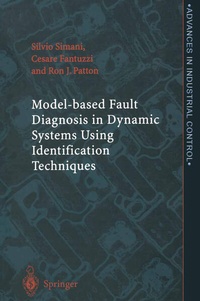
Model-based Fault Diagnosis in Dynamic Systems Using Identification Techniques
Published on 21. October 2010
Book
Paperback/Softback
XV, 282 pages
978-1-84996-895-9 (ISBN)
Description
Safety in industrial process and production plants is a concern of rising importance but because the control devices which are now exploited to improve the performance of industrial processes include both sophisticated digital system design techniques and complex hardware, there is a higher probability of failure. Control systems must include automatic supervision of closed-loop operation to detect and isolate malfunctions quickly. A promising method for solving this problem is "analytical redundancy", in which residual signals are obtained and an accurate model of the system mimics real process behaviour. If a fault occurs, the residual signal is used to diagnose and isolate the malfunction. This book focuses on model identification oriented to the analytical approach of fault diagnosis and identification covering: choice of model structure; parameter identification; residual generation; and fault diagnosis and isolation. Sample case studies are used to demonstrate the application of these techniques.
More details
Series
Edition
Softcover reprint of hardcover 1st ed. 2002
Language
English
Place of publication
London
United Kingdom
Target group
Professional and scholarly
Research
Illustrations
XV, 282 p.
Dimensions
Height: 235 mm
Width: 155 mm
Thickness: 17 mm
Weight
458 gr
ISBN-13
978-1-84996-895-9 (9781849968959)
DOI
10.1007/978-1-4471-3829-7
Schweitzer Classification
Other editions
Additional editions
Silvio Simani | Cesare Fantuzzi | Ron J. Patton
Model-based Fault Diagnosis in Dynamic Systems Using Identification Techniques
Book
11/2002
Springer
€181.89
Shipment within 15-20 days
Content
1. Introduction.- 2. Model-based Fault Diagnosis Techniques.- 3. System Identification for Fault Diagnosis.- 4. Residual Generation, Fault Diagnosis and Identification.- 5. Fault Diagnosis Application Studies.- 6. Concluding Remarks.- References.