

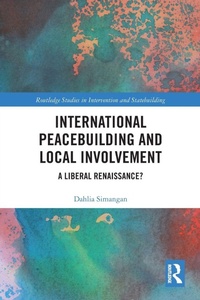
International Peacebuilding and Local Involvement
A Liberal Renaissance?
1st Edition
Published on 18. December 2020
Book
Paperback/Softback
190 pages
978-0-367-73186-1 (ISBN)
Description
This book interrogates the common perception that liberal peace is in crisis and explores the question: can the local turn save liberal peacebuilding?
Presenting a case for a liberal renaissance in peacebuilding, the work interrogates the assumptions behind the popular perception that liberal peace is in crisis. It re-examines three of the cases igniting the debate - Cambodia, Kosovo, and Timor-Leste - and evaluates how these transitional administrations implemented their liberal mandates and how local involvement affected the conduct of their activities. In so doing, it reveals that these cases were neither liberal nor peacebuilding. It also demonstrates that while local involvement is imperative to peacebuilding, illiberal local involvement restores an elite-centred status quo and reinforces or creates new forms of conflict and violence. Using both liberal and critical lenses, the author ultimately argues that the conceptual and operational departure from the holistic and comprehensive origins of liberal peacebuilding in fact paved the way for the liberal peace crisis itself.
Drawing on analysis from in-depth field research and interviews, this book will be of much interest to students of peacebuilding, peacekeeping, statebuilding, security studies and International Relations in general.
Presenting a case for a liberal renaissance in peacebuilding, the work interrogates the assumptions behind the popular perception that liberal peace is in crisis. It re-examines three of the cases igniting the debate - Cambodia, Kosovo, and Timor-Leste - and evaluates how these transitional administrations implemented their liberal mandates and how local involvement affected the conduct of their activities. In so doing, it reveals that these cases were neither liberal nor peacebuilding. It also demonstrates that while local involvement is imperative to peacebuilding, illiberal local involvement restores an elite-centred status quo and reinforces or creates new forms of conflict and violence. Using both liberal and critical lenses, the author ultimately argues that the conceptual and operational departure from the holistic and comprehensive origins of liberal peacebuilding in fact paved the way for the liberal peace crisis itself.
Drawing on analysis from in-depth field research and interviews, this book will be of much interest to students of peacebuilding, peacekeeping, statebuilding, security studies and International Relations in general.
More details
Series
Language
English
Place of publication
London
United Kingdom
Publishing group
Taylor & Francis Ltd
Target group
College/higher education
Professional and scholarly
Postgraduate, Professional, and Undergraduate
Product notice
Paperback (trade)
Dimensions
Height: 234 mm
Width: 156 mm
Thickness: 11 mm
Weight
297 gr
ISBN-13
978-0-367-73186-1 (9780367731861)
Copyright in bibliographic data and cover images is held by Nielsen Book Services Limited or by the publishers or by their respective licensors: all rights reserved.
Schweitzer Classification
Other editions
Additional editions
E-Book
05/2019
1st Edition
Routledge
€61.99
Available for download
E-Book
05/2019
1st Edition
Routledge
€61.99
Available for download
Book
01/2019
1st Edition
Routledge
€206.10
Shipment within 15-20 days
Person
Dahlia Simangan is a Japan Society for the Promotion of Science (JSPS) postdoctoral research fellow at the United Nations University in Tokyo. She holds a PhD in International, Political, and Strategic Studies from the Australian National University.
Content
Introduction 1. Locating a Middle-Ground between Liberal and Local Trajectories in Peacebuilding 2. Cambodia: Politicized Involvement in a Compromised Peacebuilding 3. Kosovo: Superficial Involvement in a Co-opted Peacebuilding 4. Timor-Leste: Exclusive Involvement in a Fragile Peacebuilding 5. The Perils of Liberal Peacebuilding and Pitfalls of Local Involvement Conclusion