

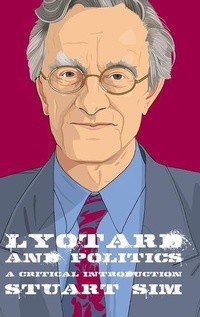
Lyotard and Politics
A Critical Introduction
Published on 27. October 2020
Book
Hardback
184 pages
978-1-4744-5651-7 (ISBN)
Description
It is Jean Francois Lyotard's political focus that singles him out from his poststructuralist and postmodernist contemporaries. He is invariably 'thinking politics': finding ways of translating philosophical thought into a basis for political action. Stuart Sim explores how Lyotard's brand of pragmatism can provide a focus for political theory and action in our cultural climate, especially in light of the dramatic resurgence of right-wing extremism.
Reviews / Votes
It is genuinely intellectually refreshing and invigorating to see Lyotard treated with the urgent seriousness that Sim brings to his work. With an impressive grasp of the entirety of Lyotard's philosophical politics, Sim gives us the opportunity, perhaps for the first time, to understand Lyotard's continued pertinence for anyone who would be both critical and political. -- Thomas Docherty, University of WarwickMore details
Series
Language
English
Place of publication
Edinburgh
United Kingdom
Target group
Professional and scholarly
Product notice
sewn/stitched
Cloth over boards
Dimensions
Height: 234 mm
Width: 156 mm
Thickness: 13 mm
Weight
435 gr
ISBN-13
978-1-4744-5651-7 (9781474456517)
Copyright in bibliographic data and cover images is held by Nielsen Book Services Limited or by the publishers or by their respective licensors: all rights reserved.
Schweitzer Classification
Other editions
Additional editions

E-Book
09/2020
Edinburgh University Press
€0.00
Available for download
Person
Stuart Sim is retired Professor of Critical Theory at Northumbria University. He has published widely on critical theory, and is a Fellow of the English Association. Amongst his recent publications are The Lyotard Dictionary (2011), Addicted to Profit: Reclaiming Our Lives from the Free Market (2012), Fifty Key Postmodern Thinkers (2013), and, with Brett Wilson and Barbara Hawkins (eds) Art, Science & Cultural Understanding (2014).
Content
1. Introduction: Thinking Politics with Lyotard Lyotard's StyleNotes
2. 'Philosophical Politics' in the 21st CenturyPhilosophers and IntellectualsLyotard's PostmodernismPeregrinations: Thinking Politics FluidlyLeft PopulismPosthegemony and PopulismLittle Narratives and Liberal DemocracyPhilosophers Against the SystemNotes
3. Relativism and the Problem of Value JudgementJust RelativisingJudging FascismJudging LyotardPragmatic RelativismConclusionNotes
4. Lyotard and the Post-Marxist TurnThe Rise of Post-MarxismAlgeria: The Limits of Marxist ThoughtLibidinal Economy: Marx and DesireThe Answer to Grand Narrative: The Postmodern ConditionThe Viability of Post-MarxismConclusion Notes
5. The Politics of the DifferendThe Archipelago and DifferendsGender and the DifferendThe Nation State and the DifferendInternal DifferendsConclusionNotes
6. The Politics of HeideggerFarias on Heidegger Derrida on HeideggerLyotard and the Sin of ForgettingLyotard as Anti-PopulistScapegoating and 'the Jews'Heidegger Post-LyotardNotes
7. Thinking the Politics of the FutureOf Cyborgs and Cybernetic Systems'Can Thought Go On Without a Body?'Corporate Power and Robot LabourThe End is NighNotes
8. Aesthetics and PoliticsDuchamp and Aesthetic IndeterminacyModernisms and PostmodernismsNewman: No AllusionsMonory: No StoryLyotard on LiteratureLyotard on FilmLyotard on TelevisionLyotard on MusicConclusionNotes
9. Conclusion: Towards a Politics of the EventLiving with EventsSvelte PoliticsPagan PoliticsReassessing the EventLyotard as a Work of ArtDissension and Invention'How to Judge Jean-Francois Lyotard?'Notes
Bibliography, Index
2. 'Philosophical Politics' in the 21st CenturyPhilosophers and IntellectualsLyotard's PostmodernismPeregrinations: Thinking Politics FluidlyLeft PopulismPosthegemony and PopulismLittle Narratives and Liberal DemocracyPhilosophers Against the SystemNotes
3. Relativism and the Problem of Value JudgementJust RelativisingJudging FascismJudging LyotardPragmatic RelativismConclusionNotes
4. Lyotard and the Post-Marxist TurnThe Rise of Post-MarxismAlgeria: The Limits of Marxist ThoughtLibidinal Economy: Marx and DesireThe Answer to Grand Narrative: The Postmodern ConditionThe Viability of Post-MarxismConclusion Notes
5. The Politics of the DifferendThe Archipelago and DifferendsGender and the DifferendThe Nation State and the DifferendInternal DifferendsConclusionNotes
6. The Politics of HeideggerFarias on Heidegger Derrida on HeideggerLyotard and the Sin of ForgettingLyotard as Anti-PopulistScapegoating and 'the Jews'Heidegger Post-LyotardNotes
7. Thinking the Politics of the FutureOf Cyborgs and Cybernetic Systems'Can Thought Go On Without a Body?'Corporate Power and Robot LabourThe End is NighNotes
8. Aesthetics and PoliticsDuchamp and Aesthetic IndeterminacyModernisms and PostmodernismsNewman: No AllusionsMonory: No StoryLyotard on LiteratureLyotard on FilmLyotard on TelevisionLyotard on MusicConclusionNotes
9. Conclusion: Towards a Politics of the EventLiving with EventsSvelte PoliticsPagan PoliticsReassessing the EventLyotard as a Work of ArtDissension and Invention'How to Judge Jean-Francois Lyotard?'Notes
Bibliography, Index