

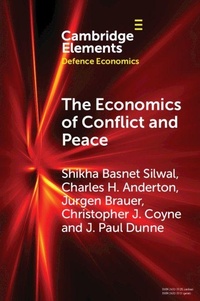
The Economics of Conflict and Peace
History and Applications
Published on 24. June 2021
Book
Paperback/Softback
88 pages
978-1-108-92624-9 (ISBN)
Description
Written for an audience of students, general readers, and economists alike, this Element is a primer on the field of the economics of conflict and peace. It offers a reasonably comprehensive, systematic, and detailed overview - even if in broad strokes - of the field's orthodox and heterodox history of thought and current theories and evidence. The authors view this Element as a baseline account on which to build a future, separate and more fully developed, work on the economics of peace, economic growth, and human development. Altogether, the Element contextualizes the field of conflict and peace economics, outlines its history of thought, highlights examples of current theoretical and empirical scholarship in the field, and maps trajectories for further research.
More details
Series
Language
English
Place of publication
Cambridge
United Kingdom
Target group
Professional and scholarly
College/higher education
Product notice
Paperback (trade)
Illustrations
Worked examples or Exercises
Dimensions
Height: 229 mm
Width: 152 mm
Thickness: 5 mm
Weight
142 gr
ISBN-13
978-1-108-92624-9 (9781108926249)
Copyright in bibliographic data and cover images is held by Nielsen Book Services Limited or by the publishers or by their respective licensors: all rights reserved.
Schweitzer Classification
Other editions
Additional editions
E-Book
06/2021
Cambridge University Press
€15.49
Available for download
Shikha Basnet Silwal | Charles H. Anderton | Jurgen Brauer
The Economics of Conflict and Peace
History and Applications
E-Book
06/2021
Cambridge University Press
€15.49
Available for download
Persons
Content
Introduction; Part I. Context and Overview;: 1. Conflict and peace in economic perspective; Part II. A Short History of Thought: 2. The Austrian school: insights on the war economy; 3. Marxian and heterodox views; 4. Neoclassical and neo-Keynesian views; Part III. Selected Theory and Evidence: 5. Conflict and the growth of government; 6. Military expenditure, war, and the cost of war; 7. Neoclassical theory: extensions and evidence; Part IV. Conflict and Peace Economics: Where to Next?: 8. The future of conflict and peace economics; References.