

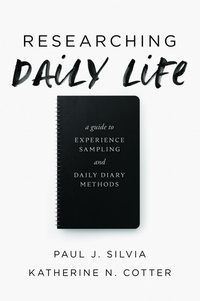
Researching Daily Life
A Guide to Experience Sampling and Daily Diary Methods
Published on 23. March 2021
Book
Paperback/Softback
165 pages
978-1-4338-3457-8 (ISBN)
Description
A step-by-step guide to researching what people do in their everyday lives.
This practical, beginner-friendly book teaches readers how to do daily life research, which is the study of what people do in their ordinary environments in their everyday lives.
The basic approach is to collect data intensively over time, at least once a day for many days, in people amp rsquo s natural environments rather than in research labs. Common methods include daily diaries, experience sampling, and ecological momentary assessment. Collectively, these methods trade off the control and precision of the lab for the texture, depth, and realism of the real world.
The book walks readers through the entire process of the research project, including first selecting a design and developing survey items, then collecting and cleaning data, and finally analyzing and disseminating the findings.
With example studies pulled from all areas of psychology, the book will provide students with the conceptual foundation and practical knowledge needed to examine psychological processes amp ldquo up close amp rdquo in ways that experimental and survey methods can amp rsquo t.
This practical, beginner-friendly book teaches readers how to do daily life research, which is the study of what people do in their ordinary environments in their everyday lives.
The basic approach is to collect data intensively over time, at least once a day for many days, in people amp rsquo s natural environments rather than in research labs. Common methods include daily diaries, experience sampling, and ecological momentary assessment. Collectively, these methods trade off the control and precision of the lab for the texture, depth, and realism of the real world.
The book walks readers through the entire process of the research project, including first selecting a design and developing survey items, then collecting and cleaning data, and finally analyzing and disseminating the findings.
With example studies pulled from all areas of psychology, the book will provide students with the conceptual foundation and practical knowledge needed to examine psychological processes amp ldquo up close amp rdquo in ways that experimental and survey methods can amp rsquo t.
More details
Edition
New edition
Language
English
Place of publication
Washington DC
United States
Target group
Professional and scholarly
Edition type
New edition
Product notice
Paperback (trade)
Dimensions
Height: 222 mm
Width: 154 mm
Thickness: 12 mm
Weight
257 gr
ISBN-13
978-1-4338-3457-8 (9781433834578)
Copyright in bibliographic data and cover images is held by Nielsen Book Services Limited or by the publishers or by their respective licensors: all rights reserved.
Schweitzer Classification
Persons
Paul J. Silvia is the Lucy Spinks Excellence Professor at the University of North Carolina at Greensboro, where he has been conducting experience sampling and daily diary research since the days when Palm Pilots were high-tech. He has studied daily life experiences in many clinical and community groups, including older adults, veterans, parents adjudicated for child maltreatment, and adults with depression, ADHD, or PTSD. In addition to self-report projects, he has conducted experience sampling studies that integrate neuroimaging and ambulatory cardiac monitoring.
Katherine N. Cotter is a postdoctoral fellow at the Positive Psychology Center at the University of Pennsylvania. Her work emphasizes the study of aesthetics and the arts in people amp rsquo s everyday environments, using both experience-sampling and daily diary techniques. Her recent work involves field research within art museums to illuminate people amp rsquo s aesthetic experiences within the museum context.
Katherine N. Cotter is a postdoctoral fellow at the Positive Psychology Center at the University of Pennsylvania. Her work emphasizes the study of aesthetics and the arts in people amp rsquo s everyday environments, using both experience-sampling and daily diary techniques. Her recent work involves field research within art museums to illuminate people amp rsquo s aesthetic experiences within the museum context.
Content
Preface
Chapter : What are Daily Life Methods?
Chapter 2: Choosing a Sampling Design
Chapter 3: Designing Self-Report Surveys
Chapter 4: Selecting a System for Signals and Surveys
Chapter 5: Collecting Data
Chapter : Cleaning and Processing Your Data
Chapter 7: Analyzing Daily Life Data
Chapter 8: Presenting and Publishing Your Research
References
Index
Chapter : What are Daily Life Methods?
Chapter 2: Choosing a Sampling Design
Chapter 3: Designing Self-Report Surveys
Chapter 4: Selecting a System for Signals and Surveys
Chapter 5: Collecting Data
Chapter : Cleaning and Processing Your Data
Chapter 7: Analyzing Daily Life Data
Chapter 8: Presenting and Publishing Your Research
References
Index